Historic Wisconsin Speedway Celebrates 65 Years
Joe Stariha still remembers the excitement and pure adrenaline rush he felt in the spring of 2011 after he had partnered with Gerald “Crash” Carlson and John “Gus” Omundson to assume ownership of the business of racing on the county-owned track. They couldn’t wait to start racing, to start packing fans into the stands. The novice race-track owners threw caution to the wind – and the wind whipped right back at them.
There’s a reason the dirt-track season in the Northland doesn’t rev up until May (and even then there are no guarantees). Mother Nature is far too unpredictable to bet thousands of purse dollars on her in April. Stariha, Carlson and Omundson learned that the hard way. They had just secured Amsoil as a naming-rights sponsor and were feeling pretty good about their cash flow. Starting the season and getting butts in the seats would only strengthen their financial footing.
Or so the thinking went.
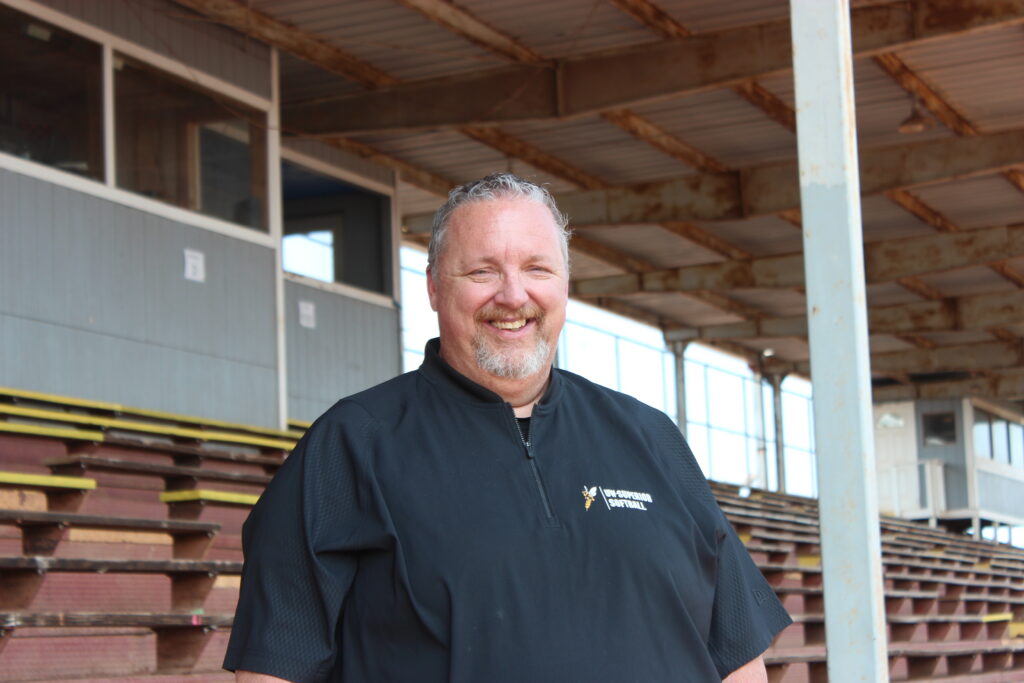
Joe Stariha
“We were all excited to open up that first year and start racing,” Stariha recalled. “We know it now, but we opened up way too early. It was 45 degrees and the wind was coming off the lake. Nobody showed up.”
And that sponsorship money?
“We blew through our Amsoil money in two weeks,” Stariha says, laughing. “It was gone in two weeks. So we’ve had to figure out the economics of it.”
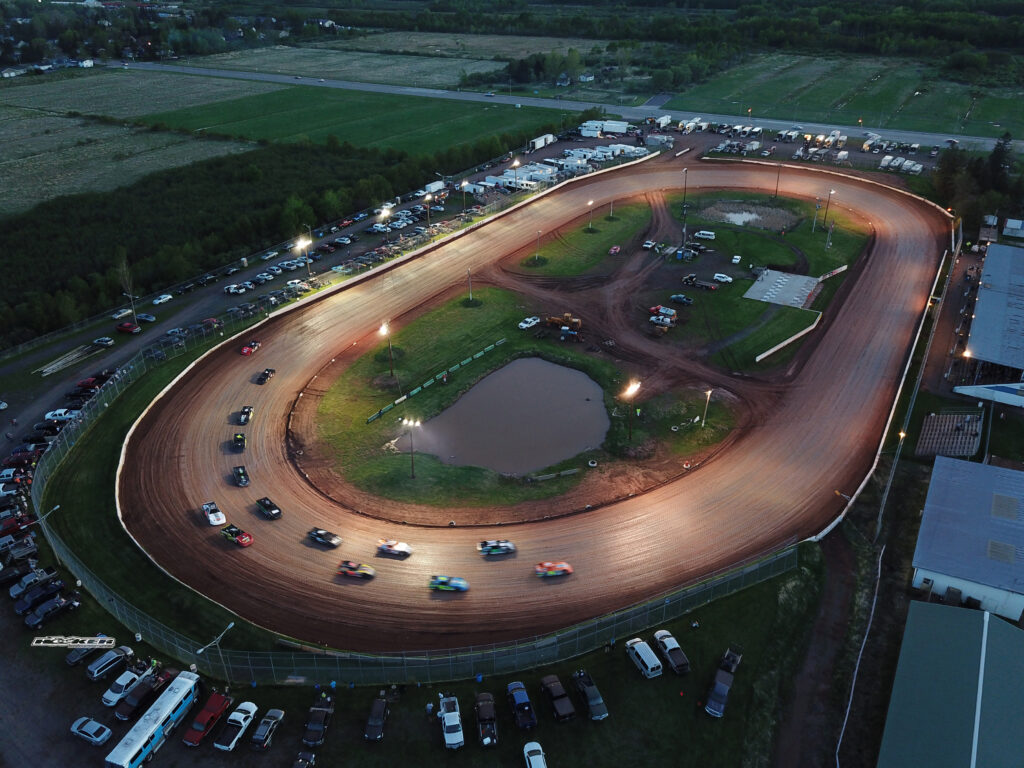
They figured out the financials – and plenty of other things about the mercurial business – during the ensuing years. Now, as Gondik Law Speedway (its name since 2018), a 3/8-mile track at the Head of the Lakes Fairgrounds, celebrates its 65th anniversary, the objective is to keep tweaking and fine tuning the product.
The clay dirt oval is revered by drivers and fans alike on the area circuit. It has become a pillar of the regional racing scene, both a relic and a testament to resilience. Nationally, auto racing is in a tough spot. Its popularity has sputtered like a car running out of gas. Local challenges exacerbate that reality. There are endless entertainment options in the Twin Ports, where weather fluctuates more than the stock market and folks have an affinity for spending their Friday nights on a lake.
Yet Gondik Law Speedway rolls along, undeterred.
Forced to Tinker, Try New Things
At a time when the biggest racing series of them all, NASCAR, is more niche than mainstream, dirt tracks nationwide have similarly encountered headwinds. Attendance is down and costs are up. More worrisome? Aging demographics suggest additional speed bumps ahead for the industry.
Those obstacles are all notable, and the team at Gondik Law Speedway is well aware of them. Which is why Stariha emphasizes the importance of innovation, of trying new things to expand and diversify the customer base. There will be immediate successes and an occasional dud, but remaining stagnant, clinging to the status quo, won’t do any good for anyone.
This past June, the speedway hosted a “Full Throttle Bingo” night, an interactive online game in which bingo squares displayed drivers’ numbers. When those drivers won a heat or feature race, fans daubed their boards hoping to get five squares in a row. Winners hustled to the press box to claim their prizes.
It was something different, something fun.
“I’d never have done something like that 10 years ago,” Stariha admits. “We had good crowds all the time back then.”
That’s no longer the case, at least not consistently. Hence the tinkering.
“Attendance is down over the last five to 10 years, and we’re all looking for different angles to get fans in the stands,” Stariha says, noting the track’s bad luck with weather in 2025. “Last year was one of the worst we’ve had in the 15 years we’ve owned it.”
Longtime Superior driver Dave Flynn has had a front-row seat to the ebbs and flows of this passion-laden pastime.
“I remember when I was a kid going to the races at Superior and it was packed,” the 40-year-old Late Model driver says. “The hard part now is, how do you get people there consistently.”
That pesky question leads Stariha, Carlson and Omundson – not to mention track owners across the country – to ask themselves: “How can we be better entertainers?”
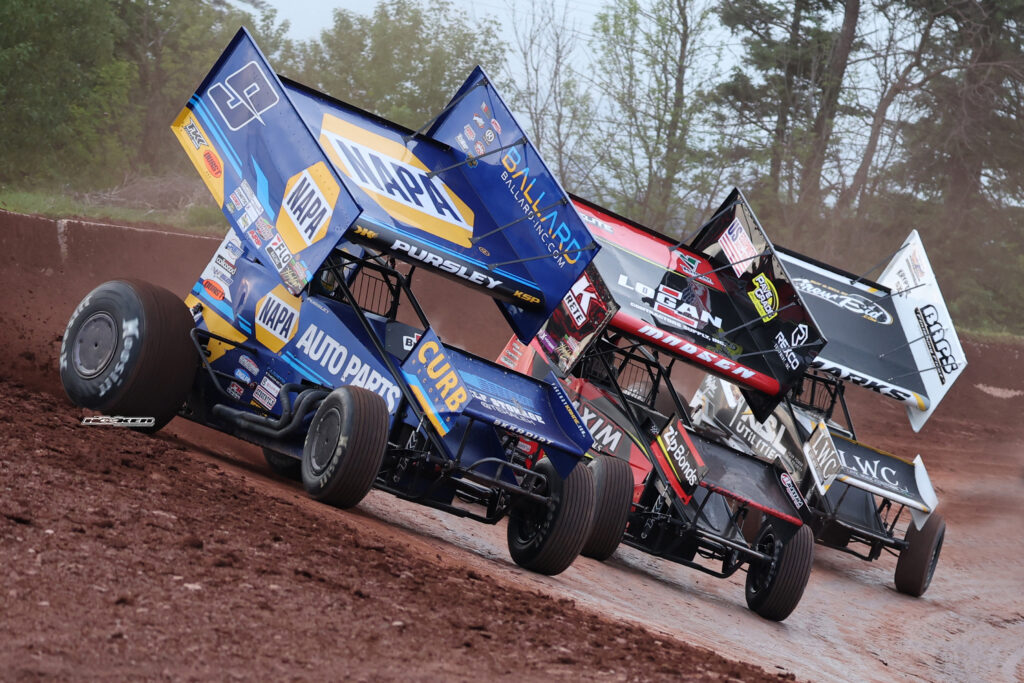
Eight days before bingo madness in June, Gondik Law Speedway hosted a huge night of racing when the Interstate Batteries High Limit Sprint Series came to town. The best sprint car drivers on the planet, including two-time NASCAR champion Kyle Larson, put on a show that delighted more than 2,000 fans. Proof that the Racing Gods were smiling down on Superior that night? It rained mercilessly across the Twin Ports – everywhere, it seems, but at Gondik Law Speedway.
“We got a few sprinkles, but nothing more than that,” Stariha says. “We were right on the fringe of it and got really lucky. All my prayers were answered.
“We saw some of the best of the best sprint cup drivers. That place was absolutely packed. It was one of the few times where we’ve done something and there were almost no complaints. Everybody seemed to be happy.”
There are between 18-20 races scheduled at the speedway each summer. Of those, Stariha estimates 12-14 actually occur; the others are casualties of weather woes. “That’s our arch nemesis,” Stariha says plainly. That was the case May 22 when races were called off due to a stiff breeze that dropped the feels-like temperature to 35 degrees. Stariha says they need about 750 fans in attendance to break even for a regular night of racing.
Stariha will keep trying to sell entertainment, whether it involves racing or something different. He says possibilities include concerts at the track and was even kicking around the idea of a circus. The speedway’s “Kids Club” is growing and continues to be a popular feature, and there is a backpack night in August.
To Flynn, the importance of engaging youngsters can’t be overstated. His 10-year-old son, Toretto, is already big into racing, thanks to video games, race simulators and especially go-karts. Out at Black River Motorsports Park just north of Pattison Park, go-karting has been a hit, with competitive points races on the clay-track oval. Often, Flynn says, go-kart races for kids occur right at regional speedways; that’s the case on Tuesday nights in Ogilvie, where they are contested inside the big track.
Kids love them. More importantly, it pulls them into the sport at a young age.
“I think that’s the only way it’s going to keep going,” Flynn says of cultivating younger drivers and fans to help sustain dirt-track racing.
Gone are the days when promoters could simply print the schedule in a local newspaper and wait for swollen crowds to show up. Now it’s all about entertaining. What can Stariha do to compel someone to spend a night – and their money – at his track?
That will always be the million-dollar question, but Stariha is also quick to underscore the true reason he got into this business in the first place. It isn’t only about making money for him, Carlson and Omundson. If that was the sole focus, they certainly could have found a more lucrative opportunity. No, money is just part of the equation. The other, and perhaps most important, part? They just love racing.
“The three of us are doing it for the love of racing,” Stariha says. “This isn’t a get-rich-quick gig. The three of us love racing and we want to make the track better, improve the facility. We want fans to come here and say the racing is awesome with a lot of side-by-side finishes. I feel like then we’ve won. When we’re providing that to the drivers and to the general public, we’ve won.
“You really get your heart and soul into this thing. It’s more about that for me than it is the dollars and cents.”
History Lesson
As the speedway celebrates its 65th summer hosting a consistent slate of stock-car racing, it’s fun to look back, to trade the fast lane for memory lane. And there is, perhaps, nobody better to narrate that journey than John Kimmes. There isn’t much – if anything – that’s happened at the track that Kimmes doesn’t know about. The official scorer doubles as the speedway’s historian, which are just two of the roles he’s held the past 50 years.
Kimmes attended his first race when he was 3, or about a decade after his mom was named the Tri-State Racing Queen, in 1967. Back then, it was known as the Tri-State Speedway, a name that lasted into the 1980s, when it became simply the Superior Speedway. Superior-based synthetic lubricant manufacturer Amsoil had naming rights from 2011-17, giving way to the present-day Gondik Law Speedway.
While this summer marks 65 consecutive years with a regular series, racing at the fairgrounds goes back much further. The venue started as a horse track, Kimmes believes, and the first automobile race was held in 1916. Regular races, on Sunday afternoons, debuted in the early 1960s. The first evening race occurred Sept. 16, 1962, a Sunday, before the speedway switched to primarily Friday nights beginning in 1963.
Throughout the speedway’s history, a total of 12 different classes have run on a weekly basis. The premier division, Late Models, is the only one that has been around for all 65 years. Since the early 1980s, WISSOTA has been the sanctioning body, except for a handful of years in the late 2000s.
Kimmes has been there for much of that history. He has stories to tell. Like the time former promoter Ron Strak secured clay for the track from an unlikely source.
“In 1998, when they were redoing Tower Avenue, Ron was able to get all the clay they were digging up and hauled right to the speedway,” Kimmes remembers.
One of the speedway’s most highly anticipated events each year is the post-Labor Day Northern Nationals. The season finale includes the Russ Laursen Late Model Classic. Laursen was a popular driver from Cumberland, Wisconsin, and a chronic winner until he was killed in a crash during a 1970 race in Fairmont, Minnesota.
Laursen’s penchant for winning included Superior, a track he loved. It hosted a memorial race in his honor that September, and a tradition was born.
Among the biggest changes Kimmes has witnessed, he says the cars, especially the Late Models with their fabricated bodies and chassis, are at the top of the list. Technology has improved more than the cars; it’s also upgraded the accuracy of scoring at tracks across the country. Electronic systems have removed the guesswork and ensure the results’ integrity – though Kimmes says he and his cohorts are still more than capable of scoring by hand if their system goes down.
There are track-management programs and apps for fans to download on their phones.
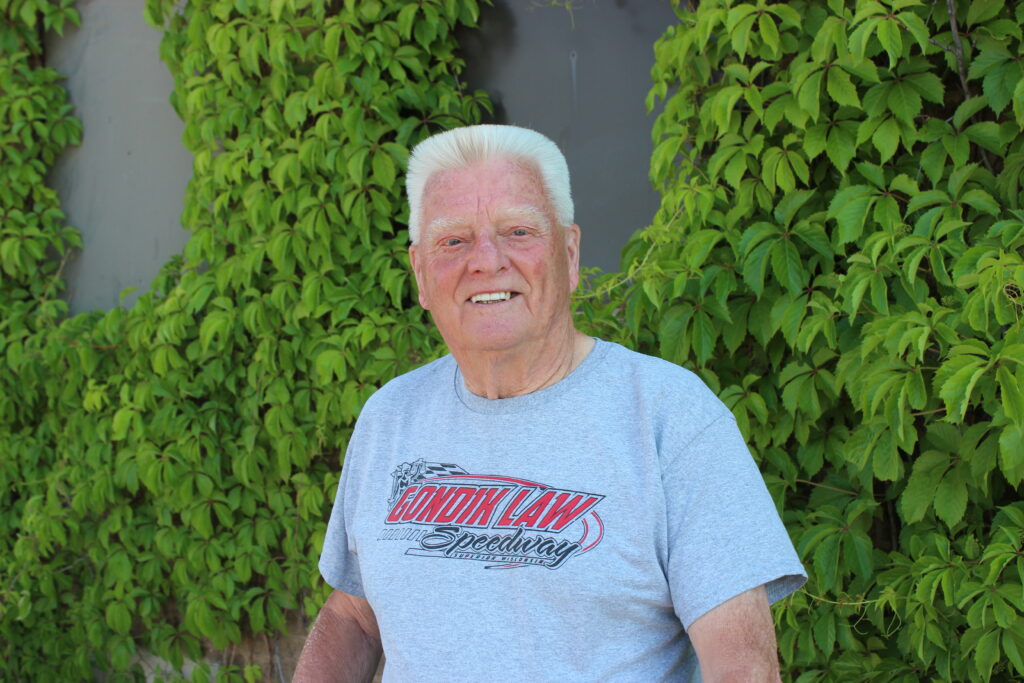
John “Gus” Omundson.
Indeed, Kimmes has seen the speedway change with the times. He officially joined the staff in 1991 as an assistant pit steward. Prior to that, he’d photograph the races every Friday night. When former historian Duane “Andy” Anderson – the man responsible for the venue’s hall of fame – died, Kimmes “kind of took on that role as well.” He’s loved every minute of it and shows no signs of slowing down.
“I was born into it,” Kimmes explains. “It’s been a passion of mine for many, many years. Going back to as a kid, it was actually kind of a dream. So when I was asked to come out there and work, it opened up some doors for me.”
Kimmes can rattle off all kinds of stats involving past and current racers. One of his favorites: Starting in June 2009, popular
driver Al Uotinen went 46 consecutive nights of completing every lap in his feature races. The total came out to 931 laps in a streak that lasted into August 2014.
“I don’t think we’ll ever see that particular record broken at the track,” Kimmes says.
Consistency, Quality in Superior
Kimmes has helped out at speedways in Proctor and Rice Lake, in addition to the many hats he’s worn in Superior. He knows what makes a good track. It has to be consistent and well maintained. Purses have to be reliable. Quality fields are a must. The facility needs to be operated with both drivers and fans in mind. People will stay away if one or some of those elements are missing. As Stariha says, you have to give folks a reason to show up in the first place, then a reason to come back.
When it comes to drivers, they’re investing their time and money into a ruthless sport that doesn’t offer much in the way of financial rewards.
“The people that are doing it really have a passion for this,” Flynn says. “You have to.”
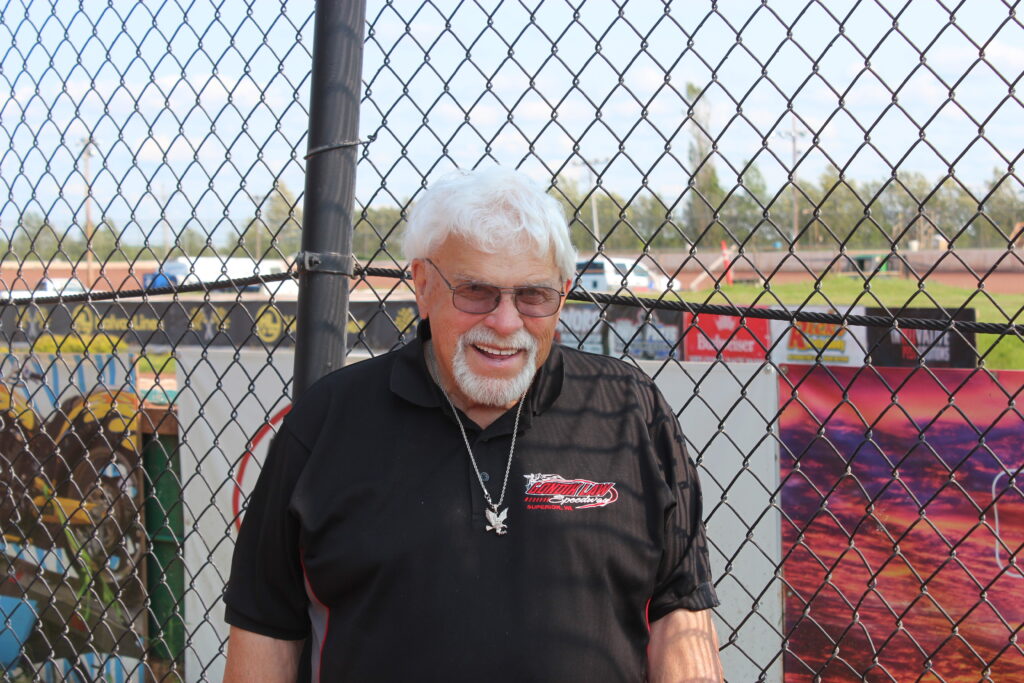
Gerald “Crash” Carlson
To Kimmes, the owner-promoter trio of Stariha, Carlson and Omundson is as good as it gets, their commitment to delivering a first-class product unflinching.
They don’t cut corners, and it shows.
“In this day and age, you see race tracks that are closing,” Kimmes says. “And these guys, they are very, very committed people. They have, by far, brought the most stability to the race track.”
If Stariha, Carlson and Omundson are responsible for stability, Dave Androsky is responsible for ideal racing conditions. He and his son, Dave Androsky Jr., handle track prep at Gondik Law Speedway. The oval is one of the favorites for drivers in the region. That’s in part because they know what to expect when they come to Superior. It’s a trusty surface tended to as if it’s the most pristine real estate on Earth.
Kimmes calls track maintenance an art form.
“Our track surface, I think, is what really sets us apart,” Stariha agreed. “Everyone loves our track prep. It’s really consistent over the course of the summer.”
Indeed, consistency is a key ingredient at Gondik Law Speedway. Many employees have been with the track for decades, creating the kind of cohesion and camaraderie that only develops through time.
“Many of us have been there for 30-plus years,” Kimmes says. “We come with a lot of knowledge. We’ve advanced with the times.”
Who says you can’t teach an old track new tricks?
Louie St. George is a Duluth-based freelance wirter.