Love Creamery’s Third Location Is In the City Where It All Began
For the past year the excitement and buzz has been steadily growing about the opening of Love Creamery in Billings Park. The latest retail scoop shop is the third for the award-winning creamery and marks a long-anticipated arrival in Superior where the business first took root.
Like any small business, it started with an idea, combined with a bit of uncertainty. “Back in the day, when I first was doing my research, probably about 2010, I was looking to start my ice cream business, but I did not want to be all in at that time,” recalled Wilde. “It was just something I was exploring, to see if I wanted to really make ice cream for a living.”
Wilde liked her idea, but it wasn’t the only one she was thinking about. She decided it would take some research to really understand what she would be undertaking should she go forward.
Environmental
Underpinnings
For Wilde, starting a business was important, but it had to be something she could be proud of in ways that extended beyond making a dollar.
“I always wanted, at one point in my life, to run my own business, and I’ve always been an environmentalist,” says Wilde. “My first job was an internship with the National Audubon Society in Washington, DC, working on the Endangered Species Act. I went on to work in the Peace Corps and AmeriCorps; both on projects that were focused around health and sustainability. I have a real passion for our planet and all the things that live on our planet. It’s just something I’ve had since I’ve been a kid catching salamanders and playing in the forest; something that’s very primal to me.”
She wanted to embody those values and passions in a business.
“I thought perhaps one way I could have maybe a bigger impact than what I was doing for the nonprofits was to do something that has a sustainable bent in a capitalist economy.”
For Wilde, that meant sourcing foods locally, lowering that carbon footprint for bringing food to your plate. “If you can go local and work with businesses that are doing more sustainable organic practices, I feel like that’s contributing to a reduction of our impact on our ecosystem.”
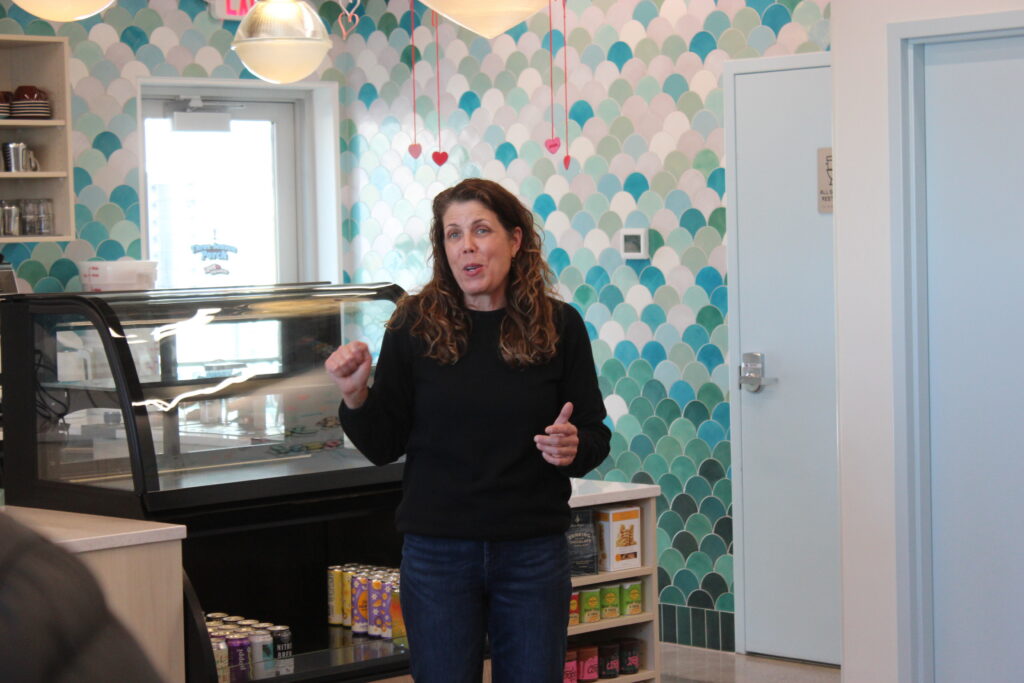
Wilde, a native of Wauwatosa, Wis., likes to farm and loves the outdoors. She started to think of ways she could possibly use what she farmed in a product.
“I had multiple iterations of a business idea, including a native seed company to a very big kind of organic hamburger company. At any rate, I did land, after doing several business plans, on maybe just learning how to do one thing really well. That I could use organic ingredients and ice cream seemed to be something no one was really focusing on locally in that space at the time. That’s really how it started.”
Following up on her idea, Wilde started making recipes and attending classes, learning about different ways to infuse cream with plants she grew and make sorbets from fruit grown in her garden. “It just seemed to blossom from there.”
Translating her idea into action was going to require more than just a passion for sustainability. “I started with the product and a vision of the kind of business I wanted, but I wouldn’t say I was gonna do exactly two stores and do this,” she said about her current business model. “As a matter of fact, I was planning on doing more wholesale up front than doing the scoop shops.”
To that end, she embarked on a research road trip, traveling to both coasts to “visit” with ice cream manufacturing companies.
“They were so kind to meet with me and show me their operations and share their insights, which was incredibly helpful. They were all very different. I mean, they’re all making ice cream and they were doing the artisan ice cream; I focused on that piece, but they had different business models, different products, different suggestions on supply chains.”
Some of the things she gleaned right away was how big a walk-in space she would need to start with, the dos and don’ts, challenges in the marketplace, what it’s like to deal with a local dairy, ideas on how to process some things, and packaging.
“Hardcore” was how Wilde described her visits, touring the operations, talking about their financials as opposed to saying hello and having a cup of coffee. “I gleaned a ton. I would say I probably did about 12 of those.”
After her trip, it was time to put ideas into action.
Superior Business Center’s Commercial Kitchen
Wilde started out with an ice cream cart at local farmers markets, but it really wasn’t making money. She was at a crossroads; either just end the operation or try to take it to the next level, a retail store.
Looking for a community commercial space to make ice cream without having all the initial investment, Wilde learned about the Superior Business Center and its commercial kitchen.
“It was great because I had all the equipment I needed, except for my ice cream machine and a blast freezer. It had a walk-in and dry storage, all the ovens and other things that we use to make nuts and inclusions that go into our ice cream,” said Wilde. “That really was where I launched the business. I was in there from 2014 until 2018 when I opened our first retail location in Duluth.”
For a food business, the commercial kitchen plays a vital role in the local small business economy. Prior to starting her business, Wilde’s only food industry experience was working as a server during college.
“Once I started doing the business plan, I was like, gosh, I need all this equipment, and I really don’t know if I want to do this. I mean, it’s just an idea at this stage,” reflected the entrepreneur. “Spending $150 -200,000 getting my own commercial space, which would be a small footprint, was more than I was willing to put into for something I wasn’t sure I wanted to do.”
The commercial kitchen allowed Wilde to test the waters without having all the capital investment on the equipment.
“It was also nice just to have some peers alongside that I could bounce ideas off of, get ideas or just advice. The model works really nice because, again, I was just trying this idea. I was only making ice cream in the summer, so in the offseason, I was paying a minimal amount for storage, but I wasn’t having this big, large rent when I wasn’t making ice cream. It worked out very nicely.”
Batch Process &
Sustainable Sourcing
There’s two ways you can make ice cream, by the batch or continuously. Love Creamery is considered a small batch artisan ice cream shop. Not sure what that means?
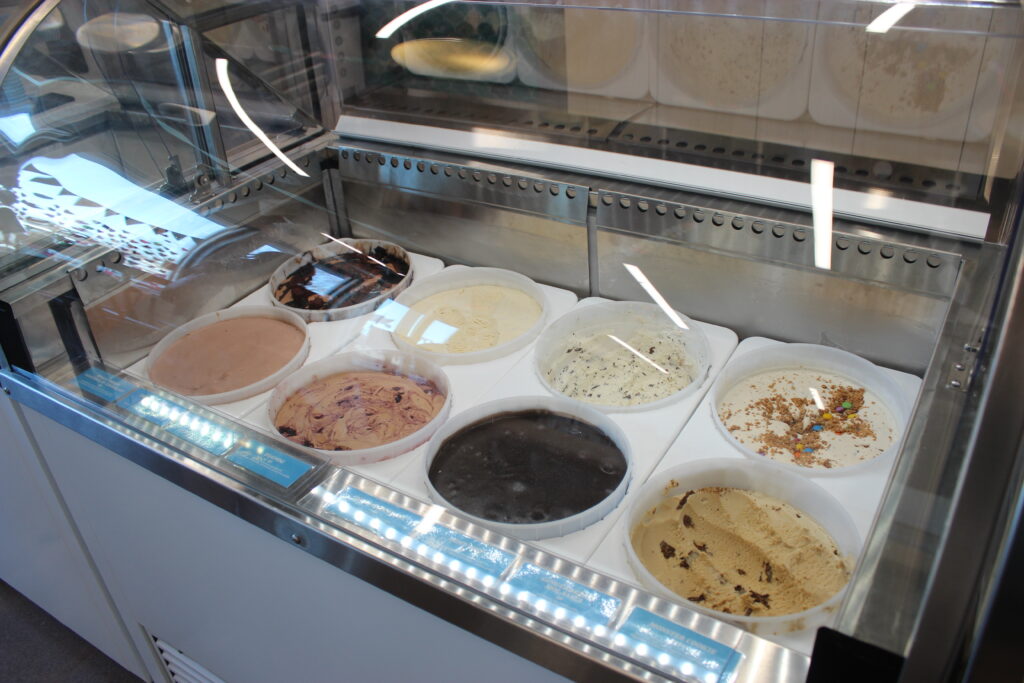
“Think of it as making brownies. You put a recipe into a mixer, but there’s only so much that mixer can hold, and that’s a batch. It’s the same with ice cream. You have an ice cream freezer that can only hold so much, and that’s a batch,” says Wilde. “With our batches, we can put 12 quarts in two of our freezers. When we do our 12 quarts we’re making about 2.5 tubs of ice cream. That’s how small it is. In the summer we can go through a lot of those a day, of any flavor; they’re small batches.”
The folks at Love Creamery are always coming up with new flavors. All three Love Creamery scoop shops carry four core flavors; mint chocolate chip, vanilla, chocolate and salted caramel, but be forewarned, not all scoop shop batches are created equally. Aside from the core four, the goal is for each shop to have unique flavors not found in the other locations.
Traditionally, Wilde has come up with the new flavors, but recently she has in a sense, opened Pandora’s box, allowing staff and customer input for adding new items to the menu.
“Most of our flavors either started with an ingredient I wanted to play with and make a flavor from, or were inspired in other ways,” Wilde explains. “Maybe I went out to dinner and had a dessert and thought, ‘Oh, I can just deconstruct that and make an ice cream flavor out of it,’ or I’ve read something in a cookbook and thought that could be an interesting ice cream flavor.”
Historically, it started with items from Wilde’s farm, like the mint that has become mint chocolate chip, one of her core flavors.
Staying true to her ideals, Wilde makes every effort to sustainably source her ingredients. “When it comes to more exotic things like chocolate or vanillas, we play with those ingredients to make a flavor. If it’s single origin, or if it’s just more of a blend of different cacao beans, we’ve vetted it for where it comes from and how it’s harvested.”
Local delicacies like honey and maple syrup are mainstays in the Love Creamery kitchens.
“We have a lot of honey flavors. We have maple flavors; things that grow in our in our woods, in our backyard. We also play with heritage types of things. We have a lot of Finns here, so we have a salted licorice flavor, as well as lingonberries and cloudberries; things that are a nod to the area’s Scandinavian heritage. I lived in the Caribbean in the Peace Corps so I’m always pulling in Latino flavors from there. I was in India a couple years ago, so pulled flavors from there,” explains Wilde, whose travels gravitate to food and inspiration.
The Dairy
The ingredients add the flavor, but the dairy is the magic. “When I started, I had to find a dairy that would supply us, and that was a lot harder than you think, because we’re teeny; we don’t buy a lot.”
A lot of organic dairies were selling to Organic Valley. “They milk their cows, a tanker comes up, they grab the milk, and they’re gone, and they’ve sold it all.” The farmers had no incentive to do all the extra work to sell her what amounted to almost nothing. She needed to find an operation willing to work with her.
Wilde finally discovered a creamery in the Cities who were getting some of their mix from the DeRosier family’s Crystal Ball Dairy in Osceola.
“They were willing to work with me and we began fine-tuning my recipe,” explained Wilde. “In the meantime, I talked to another dairy, Pat Daniger’s Autumnwood Farm in Forest Lake, but they didn’t want to do it. Unfortunately, my dairy burnt down eight weeks before we opened the first store.”
For Wilde, the silver lining which emerged from the tragedy was that Daninger happened to be friends with the DeRosier family and started helping them out, which included making the base that Nicole and Barb DeRosier had developed for the ice cream.
“The great success story here is, it was not only great for us; it was a value-added product that they didn’t have. It didn’t fluctuate with commodity pricing. Pat Daninger told me the other day, ‘We went from, how do we keep our doors open to how do we keep people away from our doors.’ They now supply nearly all the ice cream manufacturers. So, when somebody says, were you using local dairy? I can say without a doubt – we were there, we’re the reason they’re using local dairy. This is something I’m very proud of,” says Wilde.
Love Creamery is diligent about not only making delicious ice creams, they are committed to providing allergen- and gluten-free products for their customers.
“We really focus on trying to be gluten-free as much as we can. We have a pretty big following in that category of people that have an allergen; they love coming here because we really cater to them. We have folks that choose to come here because of that; they can come here and enjoy something and not be left out. That’s our goal,” says Wilde. “People can say they’re into sustainability, but I can say, without a doubt that we are really into sustainability. We have led other businesses to be able to do what they’re doing, which just means we’re innovators.”
The Right Ingredients:
Love Creamery Scoop Shops
The commercial kitchen in the Superior Business Center was a stepping stone in the progression of the fledgling Love Creamery.
“It’s an incubator where people should eventually get up and go and grow their business someplace else, which is exactly what I did,” explained Wilde.
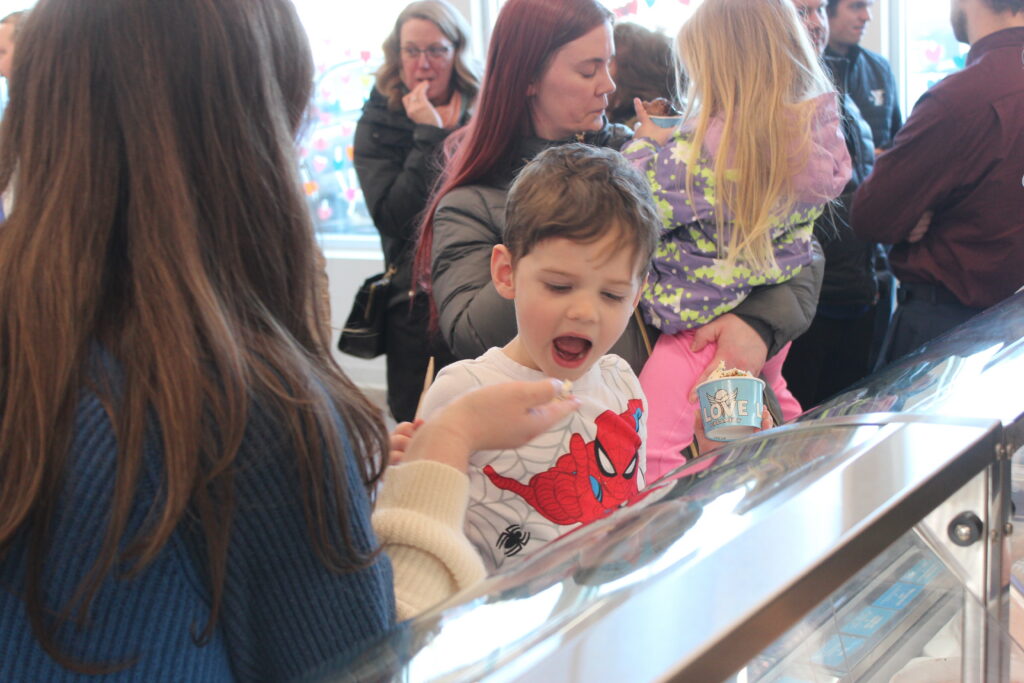
Her first store opened in West Duluth’s Lincoln Park in 2018, followed by a second location in the Canal Park district and, now, Love Creamery has come full circle with a third retail store in Superior.
On average, Love Creamery has between 30 to 40 employees, a number that roughly doubles by mid-summer. “We’re always hiring people, either teachers or high schoolers or college people that are off for the summer.”
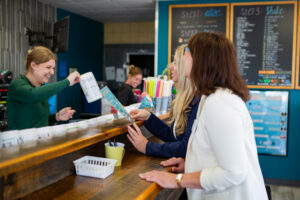
While all of Love Creamery’s scoop shops feature a full espresso bar, plus goodies like custom ice cream cakes, ice cream sandwiches and bars, Wilde says the Superior store will have something new, a bakery, replete with a pastry chef.
“She’s really good, and has developed some new, gluten-free baked items. We’re doing scones and galettes and different cookies while focusing on that gluten-free bandwagon. We now have those things in the morning, and folks are starting to come in.”
On the Superior side of things,
Wilde is very excited to be here
We’re making this our new headquarters. We now have what we haven’t had before; office space, meeting space and our own place to connect on a daily basis together as a team. I’m super excited about that,” says Wilde. “The goal is to grow this up from a couple scoop shops to a real manufacturing business where we’re offering our super creamery products to people in the Midwest and maybe beyond via online sales.”
Owner Nicole Wilde is also excited about the location and the benefits it has to offer.
“What I really like about this particular location is that it’s in a community. I like the idea that neighbors could walk here and gather after a sports game, or just come have a coffee when they’re walking their dog, or kids could come after school,” says the Wisconsin native. “I like that it’s off of a busy street, so it’s a little bit quieter. It’s near the park, near the ski trails, near the bike trails. There’re just so many great things about it.”
Patrick Lapinski is a freelance writer who grew up in Superior.