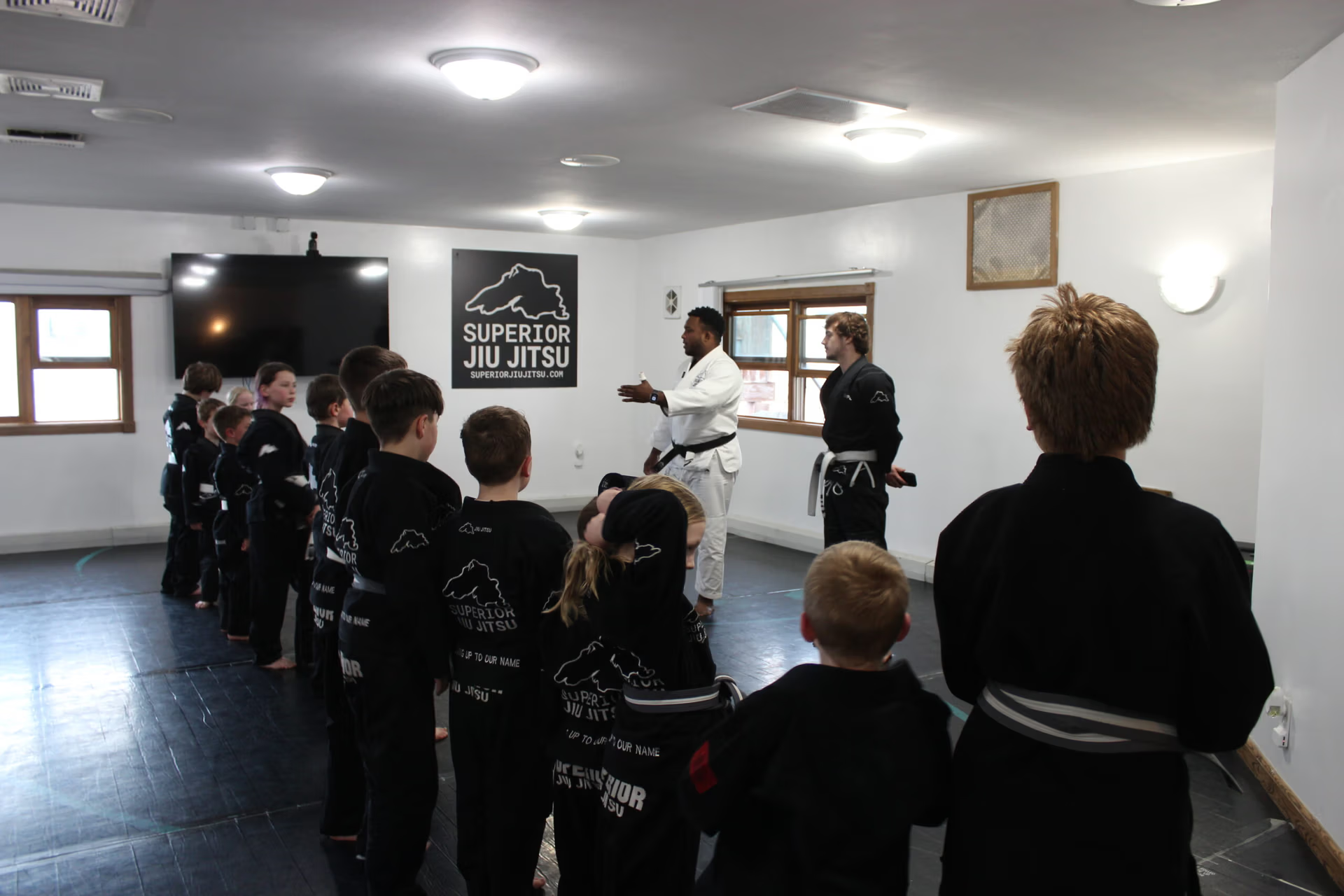
Lael Rodrigues is Celebrating One Year in His Gym, Superior Jiu Jitsu
When Lael Rodrigues took a leap of faith and moved to Superior from Sao Paolo, Brazil, in 2023, he didn’t plan to make a living by teaching jiujitsu. Others around him, however, had different ideas.
After all, teaching jiujitsu is what Rodrigues, himself a black belt, had spent the previous 10 years doing. And, with a personality equal parts charismatic and easygoing, it seemed like a foregone conclusion that he would share his knowledge of the popular martial art with the Twin Ports.
Rodrigues and his wife, Marcella Rigaud, gave themselves six months to acclimate to their new home. If the change wasn’t going well by their self-imposed deadline, they would consider returning to Brazil. Four months in, he says, it wasn’t looking good. But by the fifth month, “things started happening.”
One of those things was jiujitsu, which Rodrigues had gradually – and begrudgingly – started to teach, if informally in the basement of Hope Church in Superior. His friend, and one of the main reasons Rodrigues came to Superior in the first place, Jeremy Skaggs, was the pastor there. As more people sought out Rodrigues’ teaching and training in the Brazilian style of jiujitsu, they asked if he was going to open a gym so he could have a more suitable space for his classes.
“No, I have no money to invest,” he would reply, admitting that his philosophy of providing lessons for free didn’t help the cash-flow situation.
Skaggs would become Rodrigues’ business partner. With that well-timed helping hand, and with interest in his classes skyrocketing, Rodrigues opened Superior Jiu Jitsu in Doc’s Gym on Belknap Street in April 2024. He now teaches more than 100 students and averages six classes a day.
Rodrigues acknowledges his reluctance to teach jiujitsu upon arriving in town. He wasn’t sure if there was enough demand to justify a new business. He also worried about the fact that English isn’t his first language – though he speaks it very well.
“I was resisting at first, even though I knew deep down in my heart that it was still there,” the 35-year-old says of his passion for jiujitsu. “But I didn’t want to get into teaching just for something to do.”
Rodrigues is glad he listened to his heart – as well as those around him, at Hope Church and elsewhere.
“I wasn’t planning on teaching, but they were really persistent,” he says, laughing. “They really gave me my first push. They believed in me.
“Then it was like, ‘OK, I’m going to be the best teacher I can be.’ ”
Brazilian jiujitsu was born from traditional Japanese jiujitsu. Whereas the traditional version incorporates grappling and striking, Brazilian jiujitsu emphasizes ground fighting, getting your opponent into a position that forces submission through proper leverage and a strong grip. It’s ideal for street fighting and self-defense, which helps to explain its popularity.
For Rodrigues, being able to use it in real life is what makes Brazilian jiujitsu so valuable. It’s practical.
“If you come here just once, I’m going to teach you at least two ways to defend yourself,” he says. “If you never come back, I’ve at least taught you that much.”
That’s often more than enough. Self-defense is the motivating factor for many of Rodrigues’ students.
“Learning how to defend yourself is never a waste of time,” says 22-year-old Sammie Garbers of Hermantown, who has trained with Rodrigues ever since he started teaching in Superior.
During an hourlong interview in late February, Rodrigues says time and time again that his gym is all about jiujitsu. He’s not interested in adding boxing, kickboxing, taekwondo or other martial arts.
“Since day one, it’s been jiujitsu only,” he says. “I’m a jiujitsu black belt. I don’t want to teach something I’m not good at.”
One thing that his gym most certainly is not?
“This is not a fight club,” Rodrigues barks. “This is a school.”
From Sao Paolo to Superior
Rodrigues is a native of Salvador, Brazil. He moved to Sao Paolo in 2011. A former rugby player in college, he was recruited to Brazil’s most populous city to help with an upstart program called the Novos Sonhos Social Project. He thought he could grow the program via rugby. The only problem? Nobody was really interested in rugby. Thus, he introduced jiujitsu and “it took off,” he says, using his hand to mimic an airplane climbing into the sky.
Rodrigues was involved with the social project for 10 years, which is stunning considering its perilous location neighboring a part of Sao Paolo known as Cracolandia (literally, “Crackland”), an open-air drug den where smoking crack is ubiquitous. Homelessness and crime are rampant in Sao Paolo, especially in Cracolandia.
With the nonprofit Novos Sonhos, Rodrigues began teaching jiujitsu to adults. However, he quickly realized he could make a greater impact by connecting with young kids and hopefully preventing them from getting sucked into the many evils lurking around each corner.
Enthusiasm for the social project soared, eventually reaching nearly 1,000 kids. More than simply learning jiujitsu through Novos Sonhos, Rodrigues’ students left with hope, a brighter outlook and tools to help them navigate life.
The feel-good story of Rodrigues’ involvement with the project caught the attention of a United States-based organization called Grappling Central, which sent a small team to Sao Paolo to learn more about Rodrigues. They ultimately created a 30-minute documentary. That documentary is how Skaggs learned of Rodrigues, and the pastor would make two trips to visit him and do mission work in the region.
The second visit seemingly doubled as a recruiting journey. It was a success, with Rodrigues and Rigaud moving to Superior during one of the city’s snowiest winters on record.
A far cry from home, indeed. Nonetheless, Rodrigues felt like they were right where they were supposed to be.
“I loved the area,” Rodrigues says of his first impression. “I loved Superior and Duluth, and I loved the lake. I fell in love with Superior. The people were so nice.”
He admits there was a lot of uncertainty upon leaving Brazil. They didn’t know what to expect. Would they be able to make a living and a life here?
“Sure, it was scary,” Rodrigues says. “But there was a lot of motivation, too. If you don’t have challenges in life, you’re not going anywhere.”
Immersing himself in the Novos Sonhos Social Project for a decade provided Rodrigues with an abundance of important lessons. Chief among them – how to reach people through jiujitsu; the power of community and camaraderie; the uniting potential of shared goals and sacrifice. Those lessons underpin his approach to teaching. To gain his students’ trust, he must first invest in them.
“I use jiujitsu as a tool. I love teaching and helping people. Jiujitsu is just my tool to do that,” Rodrigues says. “Jiujitsu is secondary. That bond, that community aspect is the biggest benefit to jiujitsu. It’s not just about fighting. Fighting is the last thing I’m concerned about.”
Listen to Rodrigues tell his story, and the gratitude he feels toward Skaggs is crystal clear. And for good reason. Skaggs showed Rodrigues the promise and potential of Superior. He gave Rodrigues and Rigaud a place to live while they got settled. He made his church available for training and teaching and fostered important connections for Rodrigues.
It’s unlikely Superior Jiu Jitsu would exist without Skaggs’ help and belief in Rodrigues.
“What Jeremy did for me personally, you don’t see that on a daily basis,” Rodrigues says. “I get to make this opportunity happen because of the trust he showed in me. I feel a responsibility.”
Skaggs is now a pastor at a church in New York.
A Gym for Everyone
His black belt suggests a certain level of seriousness about jiujitsu; maybe even reverence. For Rodrigues, though, it’s not only about competing or the pursuit of belts. There are so many other benefits that accompany this sport.
“When people come to train in jiujitsu, they don’t know that it’s going to change their life,” he says.
They become healthier, happier, more disciplined and more confident, Rodrigues says. And they just may find a new community along the way, where camaraderie is the tie that binds and friendships are fast-forming. That was part of the appeal for Sara Brooks, a Twin Cities transplant living in Superior.
“For me, I work from home,” Brooks, 39, says. “I don’t have an office to go into every day, so I enjoy going to the gym and meeting new people. With those bonds, it’s a phenomenal way to start your day.”
Brooks epitomizes Rodrigues’ assertion that his gym is open to everyone – men, women, adults, children, athletes and non-athletes. She has never played a competitive sport. But when Brooks stumbled upon a Facebook ad touting Superior Jiu Jitsu, she was intrigued. She clicked around, learned more about Rodrigues and decided to sign up for a free class.
“She had never done any other sport, but she tried jiujitsu and fell in love with it,” Rodrigues exclaims.
Indeed, Brooks calls it “the first athletic venture I’ve ever taken part in.” She remains grateful for the “impulsive” decision she made back in January 2024. Brooks is at the gym two or three times a week, almost always first thing in the morning.
“The culture there is so nice; it’s so inclusive and supportive,” she says. “You feel like you’re going to hang out with your family at 7 a.m. every morning and do some jiujitsu.”
Garbers agrees.
“There’s an opportunity there for everyone,” she says. “Everyone has a different fitness level. It’s kind of like a mixing pot of people.”
Put another way, gymgoers are “large, small and every size in between,” according to Erik Parks, another regular at Superior Jiu Jitsu.
Parks, Garbers and Brooks raved about the gym’s welcoming vibe. At first blush, martial arts would appear to be a testosterone-fueled environment. Perception doesn’t align with reality at Superior Jiu Jitsu. Credit to Rodrigues for setting the tone and embracing everyone.
Asked to describe Rodrigues’ personality, Brooks bursts out: “Oh, my gosh. Lael is something else. He is like the most patient man ever. He’s hilarious, too.”
Beyond the levity is a person who cares deeply for his students. Garbers says if someone isn’t at the gym for a while, Rodrigues sends them a text to check in. He wants to know how things are going at home, work and school. Do they need anything? Rodrigues cares about his pupils beyond their activity on the mat, which is why he hosts occasional barbecues, end-of-year parties, anniversary parties and other social outings.
That’s been a key to his rapid growth and the loyalty his students exhibit.
“It’s how much Lael treats everybody at his gym like they’re part of his family,” Garbers says.
The animated Rodrigues says repeatedly that he wants his students to have fun. It’s no surprise, then, that his group classes feature plenty of laughing. That’s true whether it’s a beginner, intermediate or advanced class. The private, one-on-one classes, however, tend to be a little more serious. They also are more tailored to what the student needs, Rodrigues says.
Many of his students are children, the youngest of whom is 5. Rodrigues takes pride in connecting with kids and helping to instill in them discipline, persistence and a sound work ethic.
Parents are happy to drop their youngsters off at the gym and let Rodrigues mold them for an hour at a time.
“They send their kids here because they believe in what I’m doing,” he says. “That’s a big responsibility.”
Room for Growth
Sitting on a bench in his well-lit and spotless gym, with its black mats and white walls, Rodrigues talks about expanding. It has two meanings. First, part of the room next door is unused, meaning he could knock a wall down and instantly have more space. Second, he thinks there’s enough local interest in jiujitsu to warrant a second gym, possibly in Duluth.
It’s hard to argue with his logic. A year ago, when he opened Superior Jiu Jitsu, Rodrigues had about 50 students. Doubling that number so quickly suggests ample opportunity for even more growth.
If more people follow in the footsteps of Parks and Brooks, both of whom decided to visit the gym after seeing an ad on Facebook, that growth might occur sooner than later. All it takes is an open mind and a willingness to give Rodrigues’ gym a chance, Parks says.
“I was terrified the first week or two,” he admits. “I didn’t know who these people were and what they were going to do. But I soon realized they were very protective of new members. Once you’re there, there’s such a sense of camaraderie. You become very connected with your classmates.”
There are other places to train in the martial arts in the Twin Ports. But few of them, if any, have a singular focus like Superior Jiu Jitsu.
Jiujitsu, Rodrigues says, is a lifestyle.
While his and Rigaud’s first couple months in Superior were a little rocky, he’s glad they didn’t pull the plug too soon and return to the southern hemisphere. No, they’re right where they’re supposed to be.
“This is the place I call home,” Rodrigues says.
Louie St. George III is a Duluth-based freelance writer.