The need for supporting Superior students’ mental health is growing daily. The School District of Superior continues to provide the best education possible, and in doing so, it must focus on possible ways that may deter any learning in the classroom. That is why district leadership was excited when the College of Scholastica (CSS) stepped up with a new program involving Occupational Therapists (OTs).
In 2022, CSS received a five-year $3.9 million federal grant from the U.S. Department of Education, the first-ever grant given to OTs to be in public schools for mental health. These trained professionals have the opportunity to look at processes and work in classrooms, groups or one-on-one with students to find best practices and solutions.
Bring In The Specialists
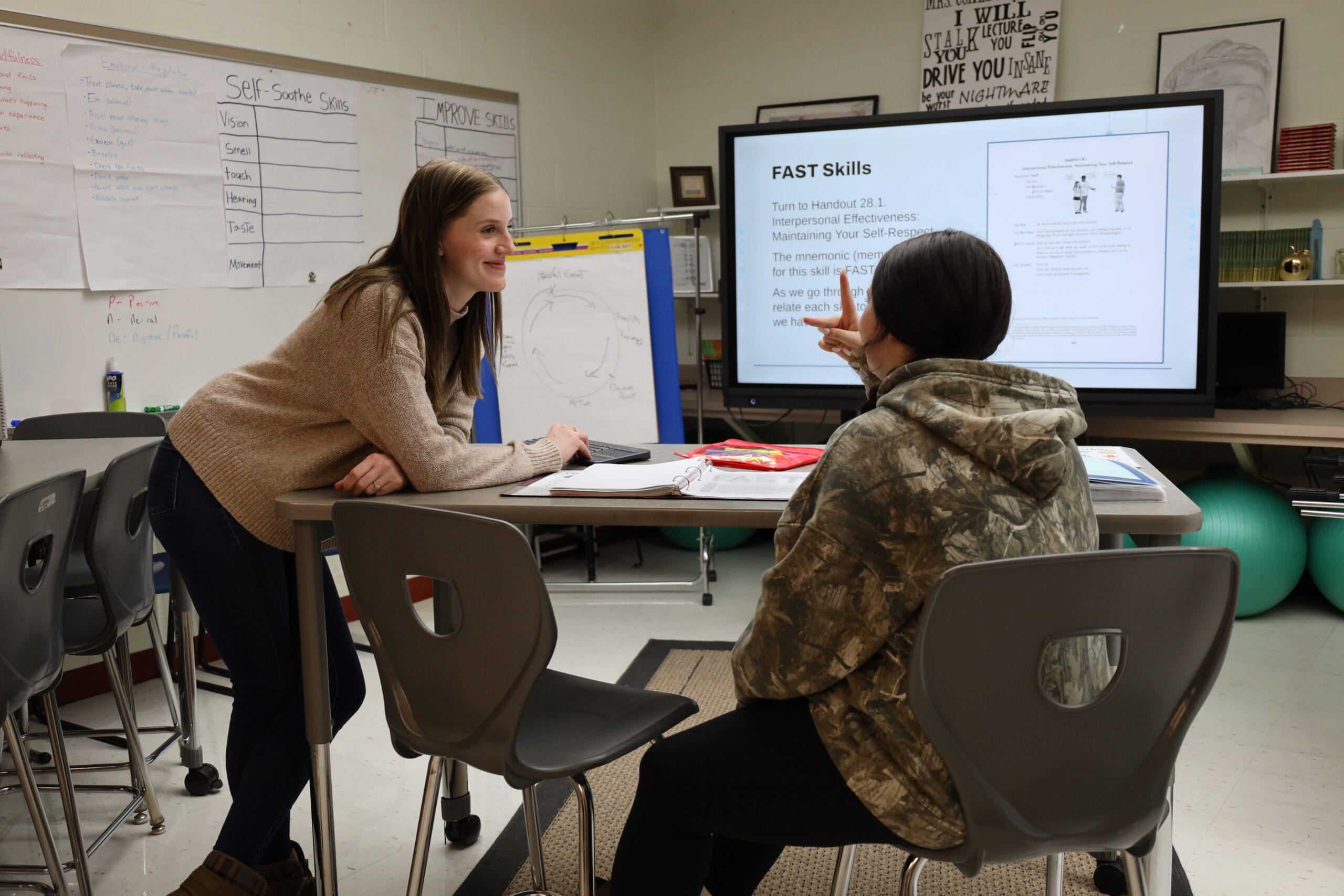
CSS entered a five-year partnership with Superior, focusing on Tier 1 and Tier 2 students. This means every student who walks through the halls (Tier 1) is provided with universal support for all students to succeed in school. Tier 2 services are provided for students at-risk for emerging mental health needs. Three occupational therapists and nine CSS OT graduate studentswork with the schools that need the most assistance: Northern Lights Elementary, Bryant Elementary and Superior Middle School.
The vision: Expand occupational therapy support to district teams to address the mental health & wellbeing needs of students in schools.
“As we started our partnership, there was the opportunity to do training with staff,” said Jamie Hunter, CSS Occupational Therapist and Mental Health Service Provider Grant Project Co-Director. “We are bringing the most current research to support school districts. During one staff development day, I hosted a session centered around positive strategies in unstructured times. For example, in the cafeteria, riding a bus, recess or walking in the hallway. How do we help our kids self-regulate emotions? How do we help students, teachers and administrators co-regulate? Sometimes, those mismatches can happen as kids come from recess and are all full of energy. Learning happens in so many different environments.”
OTs work alongside Superior staff to resolve issues, teach coping and self-regulation strategies, and improve mental health literacy.
“We’re in front of thousands of kids in a year between Superior, Rock Ridge Public Schools, Northern Lights Special Education Cooperative and Duluth Edison Charter Schools,” said Kaisa Syvaoja, CSS Occupational Therapist and Mental Health Service Provider Grant Project Co-Director. “It’s been largely positive, and people want ways to think differently about challenging things in their schools. We really want to help our students. We realize that they have a lot going on. There are social things going on, cultural things happening, and post-COVID-related stuff, and we need any way to help them succeed. But I would say that Superior has been one of the easiest school districts to work with in many ways because of district supports.”
Celebrated Accomplishments
Superior Middle School (SMS) has created the Reset & Return Room, which has significantly helped lower the number of referrals. Thanks to the overall efforts by Superior staff and various supports, SMS has seen a 60.9% reduction since 2021-2022. The R&R room is designed to teach students Dialectical Behavior Therapy (DBT) and self-regulation of emotions. Most meetings in the R&R room take about 10 minutes to resolve the issue and return students to class ready to learn. The CSS OT students and fieldwork educators have supported this initiative.
Also, at SMS, students voiced their concerns about the lunchroom. The cafetorium was often too loud and led to students having sensory overload. In response, the OTs suggested splitting students up into three places: a number of students in the stadium seating portion of the cafetorium, a midsized version of the lunchroom and a few tables in the large community events center hallway. As a result, students are happier and more focused. This created a positive climate where students can eat, socialize and take a break from the classroom.
Finally, at SMS, CSS suggested implementing a lunch break/outside time during the last 10 minutes of the lunch period. This allows students to increase engagement with structured activities and burn some extra energy before returning to class. Every grade level has seen focus improvement and a greater willingness to learn.
At the elementary level, students have increased mindfulness activities, introduced positive self-talk into the classroom, promoted positive conversations at lunch through questions of the day, and added motor lab skills, which has increased positive classroom-wide regulation and motor skills for young learners. Teachers are also seeing a change by participating in weekly prompts in the teachers’ lounge, providing a platform for them to recognize that they are not alone.
“Superior students have always been very receptive. They love OT time,” said Syvaoja. “We’ve had overall really positive experiences with school counselors and teachers as well. We’re not asking people to do anything extra. We’re coming in and doing these activities or providing resources to the teachers and ideas for how to build these mental health topics into the curriculum. It’s been really fun to see the change.”
Funding To Be Halted, What’s Next?
On April 29, 2025, The College of St. Scholastica was informed that the U.S. Department of Education has terminated funding for the Occupational Therapists as Mental Health Providers Program. The funding continues until December 31, 2025. Since then, Dr. Barbara McDonald, President of the College of St. Scholastica, has filed an appeal as she recognizes the program’s critical role in preparing graduate students and meeting the mental health needs of all area students.
“Our joint commitment to serving the mental health needs of our children remains unwavering despite this setback,” said Dr. McDonald in a written statement to the school district. “We value your partnership and look forward to collaboratively navigating these challenges as we continue to support our communities.”
Dr. Amy Starzecki, District Administrator for the School District of Superior, and Carrie Hennessey, Family Services and Mental Health Coordinator for the School District of Superior, have worked closely with the CSS team. The school district relies heavily on similar grants to support crucial services. This specific grant affects more than just students, it affects the community.
“The effectiveness of this grant and all feedback we’ve received from all stakeholders is the positive impact,” said Dr. Starzecki. “The number one issue our school district and school districts across the state are facing is the mental health needs of our student population. When I first came to this school district and after COVID, those concerns increased and did not decrease much. We don’t have dollars at the state or federal level to sufficiently meet the needs of our student population. We were depending on grants like this to supplement our budget. So, as these decisions are being made at the federal level, this is an example of how these reductions directly impact the students in our classroom. They will no longer affect access to these services.”
“CSS has been at the middle school for a year and a half, and during that time, they have already been able to build off so many pieces,” said Hennessey. “The work that they’re doing, it’s universal. It has taken a lot of time, energy and attention that can only be provided through a program like this, which we don’t necessarily have the capacity to do within our school. We’re losing out on an opportunity to continue to grow this work that’s developed over time and has morphed into addressing some of the very specific needs that our students and our staff are identifying. It’s not that we’re showing up to be able to do some coloring activities right for a short amount of time; it’s stepping back and looking at the big system and what they can provide from their professional training scope. We need community support to address the community’s needs.”
As of May 9, 2025, the school district will meet with Scholastica leaders to decide how to serve Superior students best. Current plans have been created for ongoing professional development and work through the data that they’ve learned to continue to support students in really intentional ways.
“We just thought we had additional time. We already had plans to be able to talk about sustainability and continue to support that. That’s already a goal,” said Hennessey. “It’s just shortened the timeline to be able to hold those conversations much sooner than we intended to. I don’t know. My concern is, without that dedicated group and process, it will not be the same as it could have been.”
If you would like to have your voice heard by the state and federal governments, please contact your local legislative representatives and let them know what mental health programs mean to the community.
David Coy is Communications & PR Specialist for the School District of Superior