Superior Pain Management
Being in constant pain is all-consuming. Pain can affect the quality of your work, your sleep (or lack thereof) and the amount of patience you have for your loved ones. When it feels like you’ve tried everything to treat your pain but nothing will help, hopelessness can set in.
The owners of Superior Pain Management are deeply acquainted with the life-altering effects of chronic pain. They are hoping to give hope – and help – to patients in Superior, with the recent opening of their clinic, which opened in June 2025.
The clinic offers traditional therapies, such as steroid injections and nerve blocks. There are also several regenerative modalities, considered to be on the “cutting edge” of pain treatment, such as platelet-rich plasma (PRP) and stem cell treatment. All are changing lives for pain patients.
“We don’t necessarily save lives every day, but we are improving them,” said Dr. Christopher Davies, a doctor of anesthesiology and pain medicine, and the co-founder/co-owner of the clinic. “We get to watch patients become more active with their family and friends. They often come back with a smile, they are moving better and even begin talking about the future.”
In many cases, these practitioners aren’t just improving lives; they’re restoring hope. “For some of our patients, we are their last resort,” noted Neil Anderson, a certified registered nurse anesthetist (CRNA), and the other co-owner/co-founder of the clinic. “If we can help them, it’s incredibly gratifying.”
Practitioners
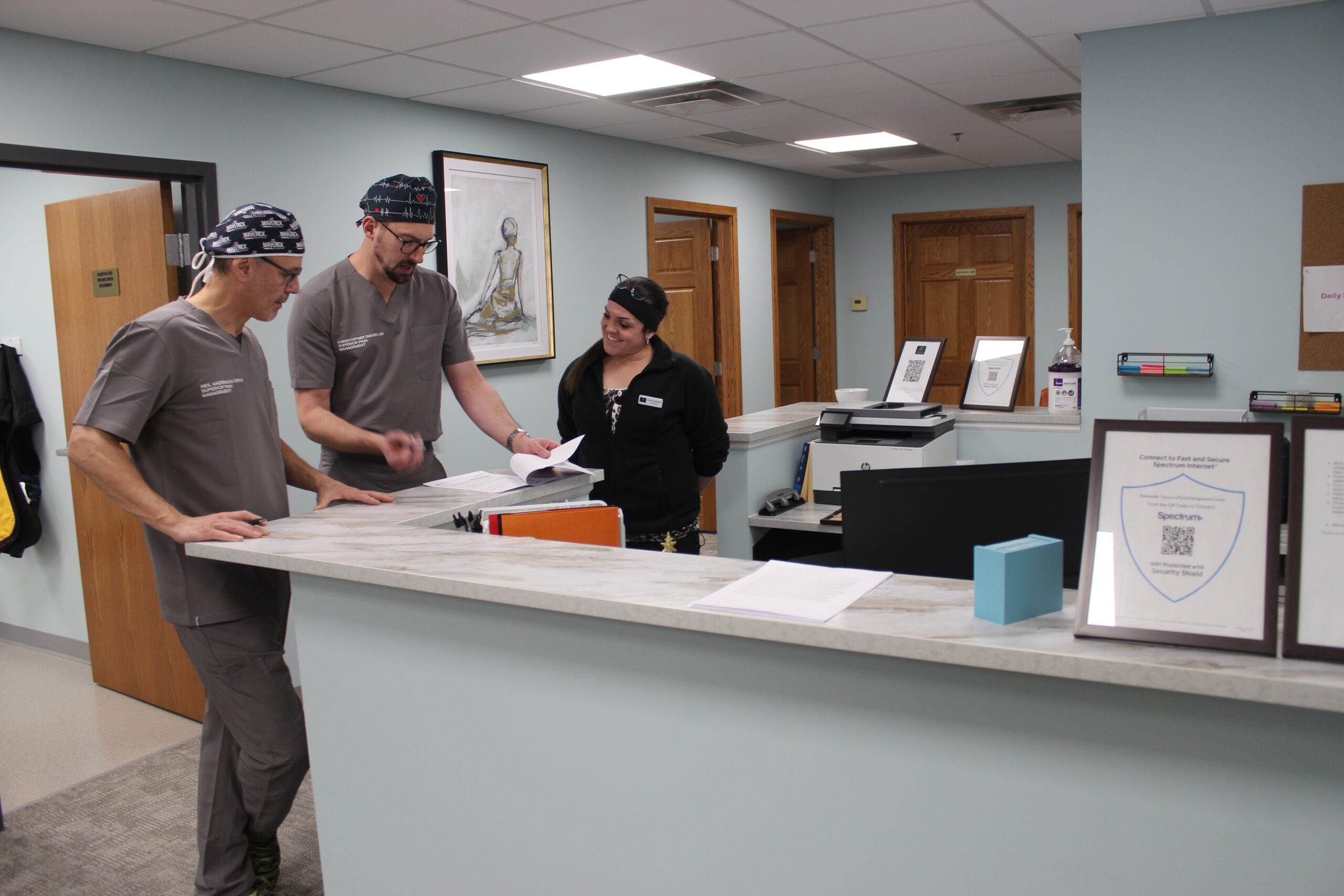
Davies and Anderson are both well-acquainted with treating pain. The two have been colleagues for years, and recently decided to become business partners with the opening of Superior Pain Management.
Anderson has a bachelor’s degree in nursing from the University of Wisconsin-Eau Claire, a master’s degree in anesthesia from the University of Wisconsin-Eau Claire, and completed a fellowship in non-surgical pain management (NSPM) from the University of South Florida. His most recent work experience prior to opening Superior Pain Management was at Arrowhead Surgery Center, Lakewalk Surgery Center and the Duluth Surgical Suites.
And, Dr. Davies has a bachelor’s degree in biology from the University of Minnesota-Duluth, and a medical degree from the University of Minnesota. He completed an anesthesiology residency from Washington University in St. Louis, and later completed a fellowship in pain medicine at Duke University. Dr. Davies continues to serve as the Medical Director and President at Lakewalk Surgery Center, and is the owner of North Shore Anesthesia and the Pain Clinic of Lake Superior.
Other team members include Jennifer Anderson, a registered nurse (also, Neil’s wife); Courtney Branley, a receptionist who also handles scheduling, charting and insurance; Taylor Minelli, a radiology technologist; and Maria Davies – Dr. Davies’ wife – who helped get the clinic up and running, and still helps in a human resources capacity.
Superior
Superior Pain Management is located in the Blaine Business Center, at 823 Belknap Street, Suite 106. At 1,700 square feet, the space includes five patient rooms.
One is designed for infusions, including ketamine infusions and IV infusions for wellness. There are three rooms designed for consultations and ultrasounds. Lastly, there is a fluoroscopy suite, which is where live X-rays of the spine and other joints are completed. The space also includes a reception area, lobby, restroom, office and breakroom.
With plenty of options in Duluth, why did Anderson and Davies decide on Superior?
“The reason we created this clinic in Superior is mainly due to the logistical advantages for patients who want to be closer to home,” Anderson explained. “We also wanted to provide regenerative medicine therapies that wouldn’t work as well at surgery centers due to the ownership structure; they would cost too much.”
Other conveniences of the clinic’s location appeal to patients dealing with pain, limited mobility or both. “We offer convenient parking, and our patients don’t have to navigate a huge building,” Davies added. “We don’t have stairs or even elevators. We put the patient first, and we really focus on the patient experience.”
Conditions and Patients
There are many conditions that cause pain. In fact, the clinic’s website (lakesuperiorpain.com) has an actual A-Z list of conditions they treat, including those related to both chronic and acute pain.
But those that Davies and Anderson see most frequently include:
- Arthritis
- Low back pain
- Neck pain
- Lumbar pain
- Spinal stenosis
- Tendon and ligament injuries
- Cancer pain
Anderson and Davies see patients of all ages. Thus far, their youngest has been 14 and their oldest was a patient in their 90s.
Treatments
Each patient at Superior Pain Management starts their journey with a consultation, which can be handled in person or via tele-health. And, as noted at the top, treatments range from the traditional to the more “emerging” types of modalities.
Steroid injections and nerve blocks are options that most people have heard of. Beyond that, there are treatments such as nerve hydro dissection – an ultrasound-guided injection therapy. Another treatment, Prolotherapy, is a procedure where a sugar water irritant is introduced, so the body can carry healing to the site.
On the more “regenerative” side, there is platelet-rich plasma (PRP) treatment, where plasma is harvested, spun down in a centrifuge, concentrated and then reintroduced into the patient’s own body, in a joint, the spine or soft tissue. Stem cell treatment is similar, in that the stem cells are harvested from the patient’s own bone marrow and reintroduced to the body.
Occasionally, surgical interventions are recommended. A few options include implantable devices, such as an intrathecal pump, spinal cord stimulation and balloon kyphoplasty.
In these cases, Dr. Davies would see the patient at one of the Duluth locations, where there is an actual surgical suite. And occasionally, when Davies and Anderson can’t help the patient, they may refer them to another practitioner; typically, a spine or orthopedic surgeon, or perhaps a rheumatologist or endocrinologist.
As many of these treatments are considered “emerging,” insurance often doesn’t provide any coverage. “Roughly half of our procedures are not covered by insurance,” Anderson said.
“With the exception of Tri-Care, which typically covers more than regular insurance. So, we try to be very transparent about our fees and fee schedule, as patients often must pay privately.”
Opioids and Cannabis
Other treatment options include the prescription of opioid medications and/or medical cannabis. Dr. Davies explained, “I don’t use opioids as a first- or second-line agent, but if a patient is in severe pain and their quality of life is poor, it is an option.”
And, regarding medical cannabis, he said, “Cannabis is a good option for some people with pain. But it’s still illegal at the federal level, which limits research. So, the data is somewhat limited.
“I’ve been certifying patients with medical cannabis in Minnesota since 2019,” he added. “I’ve certified about 500 so far, and I would say about 70% see relief. There are additional benefits for pain patients, including help with anxiety, PTSD and insomnia.”
However, the legality of cannabis can be tricky to navigate. “If the patient lives in Minnesota, no problem,” Davies said. “But if they live in Wisconsin, they are not eligible. Options for those in Wisconsin are hemp-derived products that are legal in Wisconsin.”
Aftercare and Self-Care
Patients who are most likely to find success at Superior Pain Management are willing to follow doctor’s orders. By this, we mean they agree to some after-care when prescribed, which can include physical therapy, chiropractic care, exercise and seeing a personal trainer. Optimizing whole-body health and wellness is a key part of treating pain.
“Our patients who want to proactively take part in their own care are primarily non-smokers,” Anderson said. “Additionally, they’ll optimize their nutrition, stay hydrated and limit their alcohol consumption.”
“If you don’t use it, you lose it!” Dr. Davies added. “We recommend our patients stay active with regular cardiovascular exercise, combined with weight-bearing exercises.” Davies also recommends regular checkups, eating an anti-inflammatory diet with little to no processed food and not smoking.
Success Stories and Lessons
The treatment of pain is often life-changing for patients at Superior Pain Management. Both practitioners have memorable stories to share, including lessons learned.
“I had a patient with arthritis,” Anderson said. “He was an active male in his 50s who was otherwise healthy. We did a steroid injection in his knee, which lasted about two months. Then we tried PRP, and within a week or two, he was almost back to baseline.
“I saw another patient with spinal stenosis, and surgery wasn’t an option,” Anderson added. “Then we did PRP, and he was out golfing again a few weeks later.”
And, a story that is always at the forefront of Dr. Davies’ mind is that of his late best friend. “I was not his treating physician, but my best friend was diagnosed with a cancerous mass on his pancreas at age 35.
“He received opioids for his pain, and was fully sedated through the end of life. If he was my patient, I would have treated him with an intrathecal pump infused into his spine. So, I try to remember that the treatments we offer aren’t always to extend life, but to improve quality of life, too.”
Andrea Busche is a Twin Ports-based writer and small business owner.