Wes Anderson Turned a Job Layoff Into a Business Selling Foraged Functional Fungi
Back around the turn of the century, Betty Salisbury suffered a head injury that damaged her left occipital nerve.
“For more than 20 years, I had chronic head pain,” said the Burnsville, Minn., resident. “I went to so many doctors in the beginning trying to figure out what is wrong, and the medication that they put me on is not healthy, so as soon as I could get off of that, I got off of it, and I just lived with pain.”
Then she saw the 2019 documentary Fantastic Fungi on Netflix (it’s no longer on Netflix but you can catch it on Tubi), which focuses on the health benefits of mushrooms. Betty was particularly interested in the lions mane mushroom, which in clinical trials has shown promise in stimulating nerve growth and reducing the sort of neurological pain Betty was living with.
“After I saw that, I tried to find lion’s mane in the stores, and the only thing I could find was lion’s mane mixed with other things. I never found anything that was 100% lions mane,” she said.
Then, in February 2024 Betty was at a home and garden show in Minneapolis when she stopped at Wes Anderson’s Elevated Spores booth.
“I was buying his chai tea, and then I saw lion’s mane on the counter,” she said.
She bought a 60-gram bag of Organic Lions Mane Dual Extract Powder.
“And within one week, I could feel a reduction in my pain,” Betty said. “My eye would constantly twitch on me, and that stopped. After living with chronic head pain for over 20 years, when I told people that have known me over this period of time, who knew what I was dealing with, when I told them that I found something that gave me relief, we literally cried. It was happy tears.”
Since then she takes a scant quarter-teaspoon dissolved in a glass of water daily, although she decided to try a test in the fall of 2024.
“I felt so good, I decided to stop taking it for three weeks and the pain returned,” she said. “So I’ve been taking it daily since then. I still get a reaction when there’s a barometric pressure change (common among those with neuralgic pain), but it’s not as devastating as it was before I was taking lion’s mane. It’s amazing. I have recommended it to so many people.”
Betty’s story was not the first time Wes Anderson has heard from happy customers who have found relief from his various mushroom products.
“The other day, I got a review on my Google page from a woman who bought my coffee, and she said it’s helping her with her inflammation,” he said. “A couple months ago, I got a call from another customer who said that my mushroom extracts are the only thing that have helped her with her pain, and now she can bend over and pick up her laundry, and it was the first thing that’s worked in 10 years of trying things. So anytime it gets tough, I just remember those things because it is very tough. I sometimes work too much but, yeah, it’s definitely rewarding.”
Wes grew up in Waconia, Minn., a small town 30 miles west of the Twin Cities, but it was at his grandfather’s nearby farm in St. Bonifacius that the mystery of mushrooms first intrigued him.
“I would find giant puff balls and kick them around, and I always thought they were so cool,” he said. “It wasn’t until I was in my early 20s that my uncle told me, while we’re at my grandpa’s farm, that we can eat those wild puff balls. They’re edible. And I thought that was pretty fascinating.”
His next eye-opening mushroom experience came when he was in his mid-20s working in a fine dining restaurant in Minneapolis.
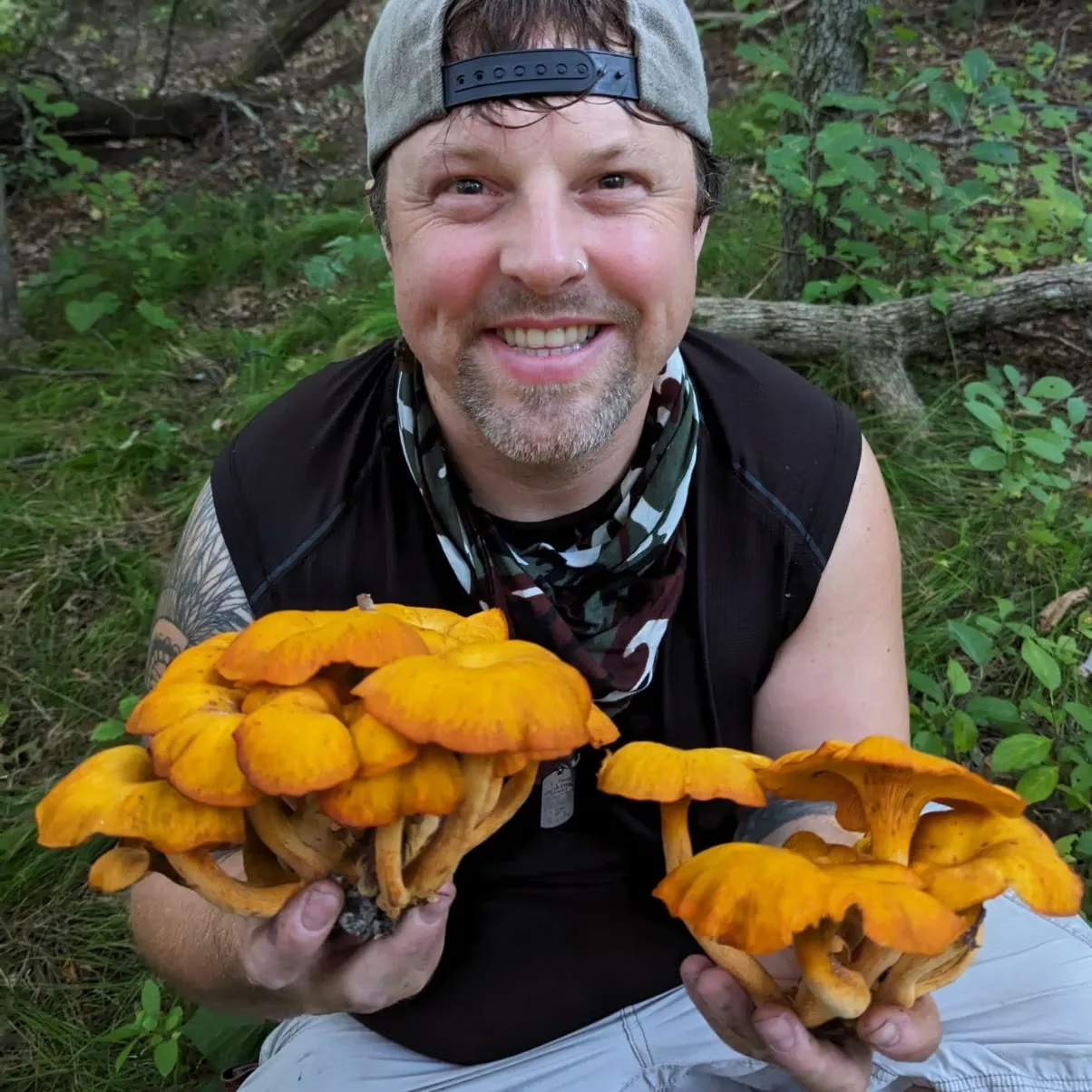
“I would see the foragers come in to sell their foraged mushrooms and plants, and I kind of got a little bit jealous because I was in the hot kitchen while they were outside in the forest. So I started trying to find mushrooms,” he said. “It took me a couple years, but I was targeting morels. After a couple years, I finally found some morels. Once I did, I was really hooked, and I went down that rabbit hole, started learning more about mycology and all kinds of other mushrooms, and all the culinary mushrooms like chanterelles and black trumpets and chicken of the woods and oysters, I was able to find all those and identify them confidently and eat them and cook with them. So that was really cool.”
When he entered his 30s, Wes decided to make a move north.
“I was living in Minneapolis, and I wanted to escape the Twin Cities and all the people, so I moved up to Superior,” he said. “I’m a very nature-focused person, the forest makes me happy. And up here, I’m 10 minutes away from beautiful hiking trails. Down there, it’s a little bit different. You got to battle traffic, and there’s not as many hiking spots around. And if there are, they’re very short and surrounded by houses and up here, you can really easily get lost in the woods if you wanted to.”
When he first moved to Superior, Wes went back to school.
“I went to UWS, and I remember I kept getting sick this one winter, and I ended up getting sick right before a midterm. I had a really bad head cold, and I ended up getting a very low grade on the exam, and then just a couple months later, it was time for finals, and I got another cold, and I ended up doing really bad on that exam,” he said. “I was realized that my immune system was really weak, and I had heard about medicinal mushrooms, or functional mushrooms, specifically chaga. So I went out and I found some chaga.
“I was a pretty big skeptic about it, that mushrooms would actually work to heal someone or to help with the immune system or anything like that. I tried it anyways, because it was free and it was fun to find. I made a tea, and I just kind of noticed that I wasn’t getting sick anymore. Over that winter and even into the next year, I wasn’t getting sick anymore.”
That experience led him to seriously research medicinal – or functional – mushrooms. But he thanks the pandemic for opening the world of mushrooms to his entrepreneurial spirit.
“When the pandemic hit, I was working at a food distribution company as a sales rep,” he said. “The pandemic kind of slowed down sales, and the company had to let people go, and I was one of those people that the company had to let go,” he said. “I didn’t know what to do. I was in a lot of turmoil because I didn’t have a job, but I kind of channeled that negative energy into something positive and decided that I want to start a business. But what kind of business?”
His education at UWS helped him find his calling.
“While I was in school at UWS, I was studying transportation and logistics, but there were some business classes, and they talked about profit margins a lot. What kind of products had good profit margins? Coffee and tea. So I knew that I wanted to start a coffee and tea business. And then I thought, I’m really good with mushrooms. How can I incorporate these mushrooms into this coffee and tea? So I decided to put my extracts into the coffee and tea and sell that.”
I actually just started out selling my liquid extracts, and they’re like in little amber two months bottles. And
“I started building out a website and designing labels,” Wes said. “My logo is actually the spore print of the very first mushroom I’ve ever spore printed. A spore print is when you lay a mushroom cap down on a piece of paper, gill side down, and you let the spores fall onto paper. I got to work building out Elevated Spores from the ground up, literally designing every function of it, and living off my savings account and a little bit of residual pay from my job that I lost.”
His first market was the Christmas of 2020 in Duluth at Dovetail Café.
“I was selling my extracts and some ground mushrooms and other mushrooms for tea,” he said.
His next product was a mushroom coffee using Duluth’s Alakef Coffee as the base.
“That’s when I kind of blew up,” he said. “But it wasn’t until I developed my instant chai, that’s when I really blew up. That’s when I was starting to make money and being able to survive off it without dipping into my savings account anymore.”
He currently sells about 15 mushroom-focused products.
“I’m always working on new products,” he said. “I’m trying to fine tune some kind of a
medicinal mushroom pet treats. Soon I’ll be coming out with a line of skin care products, because mushrooms have a lot of, yeah, mushrooms have a lot of compounds that help with skin health. I’m always creating something new.”
Wes quickly learned that Superior is an ideal location for a start-up entrepreneur.
“I was looking for a commercial kitchen to work out of, and the Superior Business Center came up on Google search as an option. So I called Jim (Caesar, head of the Development Association which manages the business incubator), and he set me up. I was in there within the week. I do some of my production there. But I have gotten bigger so I’ve been trying to work with co-packers to help with products. But, yeah, the Superior Business Center is a big, big help for small business. There’s also a business consultant I’ve been working with that’s helping me with things. I can’t say enough good things about the Superior Business Center. I’m lucky that they’re there.”
Wes says in the near future he wants to grow Elevated Spores from a one-man operation to a business with dedicated employees.
“It’s just me right now,” he said. “I’m in a weird stage of stage of growth, where I’m not quite a business owner. I’m more of a self-employed person. But I’m getting to a point where I’m going to be more like a business owner, where I would have employees, business owner. I’m still doing the hustle, where most of my sales are coming from me doing grassroots marketing.
“I really want to get to a point where I can give some passionate people some opportunities to
to help me grow my brand into something bigger and more national,” he said. “I want to eventually build out a laboratory that is mycology focused, where I can buy equipment to help make my extracts better, to help advance the science of mycology, the science of functional mushrooms I want to use a lot of my profits to really start testing different wild mushrooms for compounds that are healthy for us, because I truly believe that mushrooms hold a lot of secrets on how to keep us healthy.”
“We are definitely in the infancy of mushroom medicine. There’s a lot of research to be done,” said Alex Crum, ethnobiologist and visiting lecturer of biology in UW-Superior’s Natural Sciences Department.
She noted that although mushrooms are very different from plants, they have one thing in common.
“They can’t just sort of pick up and walk away from a bad situation. So the solution to this is chemistry. They make all these compounds that are meant to help protect them from extreme sunlight or being eaten, or to attract pollinators, in the case of plants. It’s a lot of those compounds that end up also being medicinal for us,” she said.
“The more research we do on some of these, the more promising it looks. And I’m not saying you should go out and just start foraging your own mushrooms and using them indiscriminately, but I think there’s a lot of potential there and a lot of need for more research as well.”
She is familiar with Elevated Spores.
“I tried a sample of the coffee at a farmers market and bought it. It’s delicious,” she said. “I think this is a really cool idea, and he has really cool products. I want to caution people against foraging themselves, unless they’re really confident in identifying their mushrooms,
because things can go very wrong very quickly.”
Wes said his mushroom coffee and chai are the top sellers.
“I’ve watched it go from ‘What’s mushroom coffee?’ to ‘I love mushroom coffee!’ in about five years.”
Jim Lundstrom is editor of Positively Superior.