Despite Odd Winter Weather, Fishing On Ice Still Has Allure
What began as a means of survival for cold-climate Indigenous people has developed into a million-dollar industry for the state of Wisconsin, largely because ice fishing has a mystique that appeals like no other outdoor recreational activity. It’s anglers against the elements and the fish unseen beneath the ice.
On a crisp, clear, sunny late afternoon in mid-January, a snowy parking lot on the shore of Superior Bay was full of the cars of ice-fishing enthusiasts. A young couple and two of their friends were unloading their cars and filling rugged, black ice fishing sleds with gear, food and lanterns in anticipation of an evening of fun.
As they made their way down the enbankment onto the thick, beautiful, glass-like ice, you could hear them discussing which way to go, how far out to trek and what they hoped to catch.
The late day sun, about an hour from setting, glistened off the ice and framed them in silhouette with a dozen ice houses in the distance and the S.S. Meteor moored on the far side of the bay at Barker’s Island. One couldn’t help but look at the scene with a sense of romanticism, envisioning them in the quiet solitude of the ice, warm companionship and the hope of catching the big one. Old-timers still tell the tale of “Walter,” the mythical fish lurking beneath the ice. Maybe this is the night that one of the young couples land him – catch and release, of course.
But, as many learned last winter, ice fishing is weather dependent.
Northwest Outlet has been in Scott Miller’s family since his grandpa opened the store in 1954. It’s safe to say that, during those 70 years, few winters have been as challenging as the 2023-24 season, when stubbornly warm temperatures derailed all things involving ice, snow and cold.
It was the winter that wasn’t. Forty-degree days in January and a snowfall total in Superior that was about 90 inches less than the year before. Indeed, December 2023 to February 2024 turned out to be the state’s warmest winter on record, according to the Wisconsin State Climatology Office. And it wasn’t particularly close. The average temperature for those three months was 28.3 degrees, nearly 10 degrees warmer than normal.
Douglas County wasn’t immune from the curious conditions.
In a region that prides itself on enduring brutally cold weather – and thriving despite it – last year was frustratingly mild. For many, the impacts went beyond merely limiting their favorite outdoor activities. Bottom lines were affected. Business owners whose livelihoods depend, at least a little bit, on selling winter gear felt the squeeze.
That was especially true for ice fishing, which isn’t nearly as enjoyable without ice. Of course, it really isn’t possible, either.
At Northwest Outlet, between Nov. 1, 2023, and March 31, 2024, sales of hunting and fishing gear dropped about 45% compared to the previous two winters. That’s a precipitous decline.
“There are a lot of factors that have to align in order to have a good ice fishing year, and it’s rare that all those things line up perfectly,” Miller says.
Retailers have to decide what gear to order – and how much of it – long before winter even starts. Basing those decisions on historical weather trends seems safe, but when an anomaly occurs, the consequences can be long-lasting. That was the case a year ago when ice coverage on local lakes, rivers and streams was inconsistent at best, nonexistent at worst. In mid-February, for example, the Great Lakes Environmental Research Laboratory (GLERL) found that a meager 1.7% of Lake Superior was covered with ice. Average ice coverage for that time of year is about 40%.
Going all the way back to the beginning of its record-keeping in 1973, the GLERL had never observed ice levels that low in the middle of February. Keep in mind that as recently as 2019, Lake Superior reached almost 100% ice coverage. Six years later, that doesn’t even seem possible.
It’s not just the big lake. Sam Peterson, a local angler, says he typically gets out ice fishing at least every other week during a normal winter. He especially likes a section of the St. Louis River in far western Duluth where he chases the burbot run every year. Burbot may be better known as eel pout, a bottom-dweller that tastes much better than it looks (which isn’t saying much).
“It’s one of my top-five favorite fish to eat,” Peterson says, chuckling. “People call them the poor man’s lobster.”
As much as he enjoys ice fishing, Peterson only made it out once in 2023-24, for three days in January. He estimates there were between six to eight inches of ice on the river, though it didn’t last long.
Northwest Outlet’s Miller says they made a conscious decision to scale back their ice fishing department “a number of years ago.” He wanted to diversify the store’s selection and appeal to more people and more hobbies. Relying too much on one activity is a recipe for heartburn. Especially if that activity takes place during a season that continues to shrink in northwest Wisconsin. Unpredictability is not a friend of business owners.
“If you put all your chips on black, you’re either going to come out really good or really bad,” Miller says, referencing roulette.
Year-round, Miller says the sporting goods department at Northwest Outlet, which includes hunting and fishing gear, only accounts for about 10% of sales.
“For us, ice fishing is a part of our business, but it’s not the only part of our business,” he says. “So we’re fortunate in that regard, to not rely only on ice and snow. We can’t necessarily get rid of our ice fishing stuff altogether, but it’s definitely not the area that’s keeping our lights on.”
Still, that doesn’t mean he neglects it. Northwest Outlet gets all of its ice fishing gear through distributors. Miller has to place his orders in September. Time was, he pretty much knew what to expect of the winter season and could plan accordingly. That’s not quite so easy anymore. Prognosticating what Old Man Winter has up his sleeve is much more of an artform these days, giving credence to Miller’s gambling analogy.
Miller does his best.
“In September, people are coming in wearing flip-flops and shorts, and I’m glued to the long-range forecast looking at what kind of winter we’re going to have,” he jokes.
A Shrinking Season
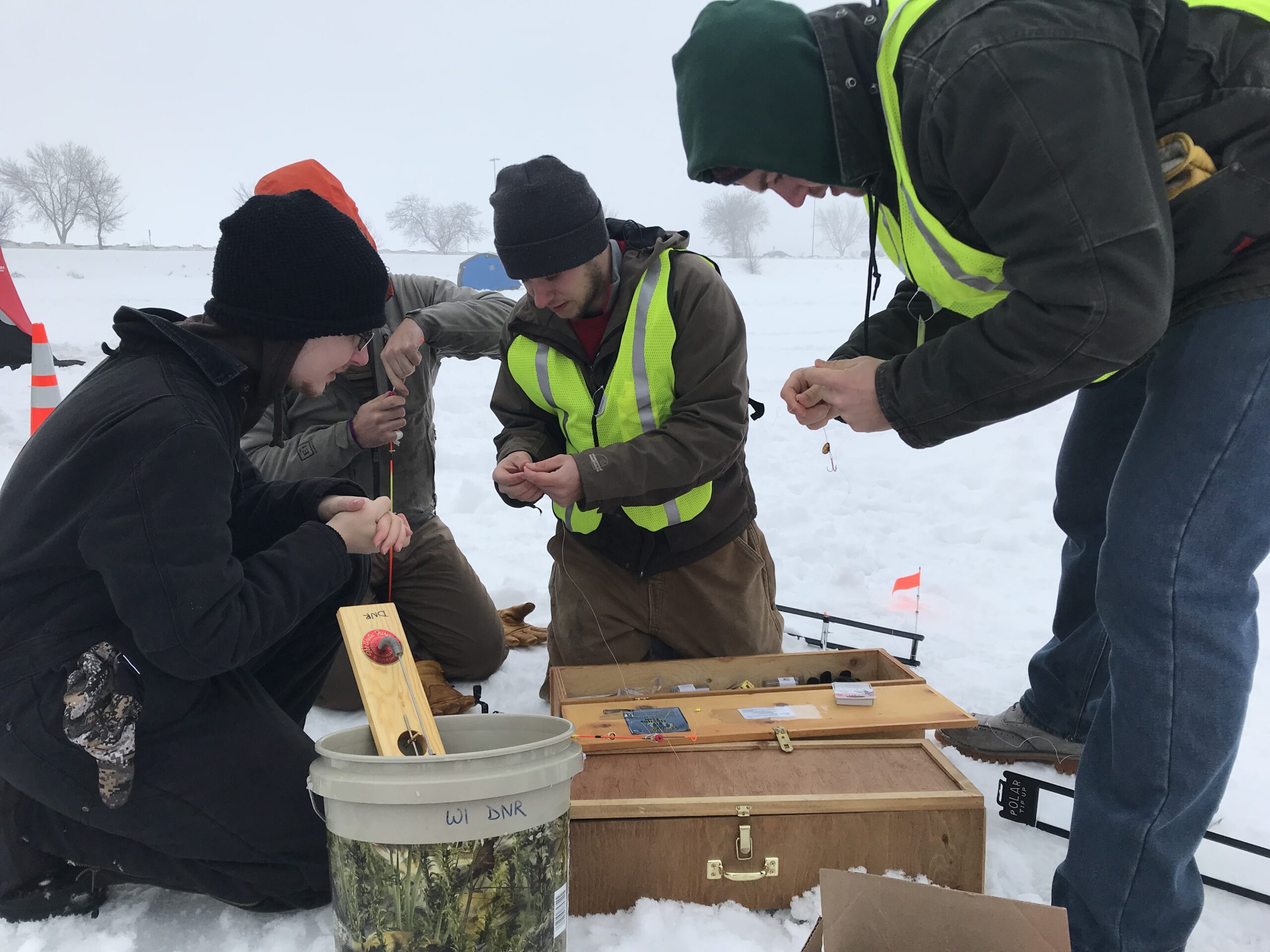
One of the Twin Ports’ favorite winter pastimes involves plying frozen bodies of water for fish. It’s a laborious hobby, but then free time is easier to come by during those first few months of the new year. If you pass by a lake or river in, say, January, you expect to see at least a few ice fishing shelters, or folks sitting on overturned five-gallon pails peering into cloudy water, jigging rhythmically, nowhere they need to be.
Peterson, a fisheries biologist with the Wisconsin Department of Natural Resources, shared results of open-water and winter surveys along the St. Louis River Estuary conducted by the Minnesota Department of Natural Resources in 2015 and 2016. The ice fishing survey occurred from Dec. 3, 2015, through March 1, 2016; the open-water survey occurred from May 9 through Oct. 31, 2016. Among the findings was an estimated 25,812 angler hours on the ice, with the majority of the activity (64.7%) happening in January. The average trip for 457 interviewed anglers was about 3.5 hours.
That’s just one popular fishery in a region teeming with them. All those ice fishing enthusiasts are confronting an unpleasant reality – their season is getting smaller. Year to year, the differences are almost negligible. But take a broader view, and it’s a different story.
The Wisconsin DNR says the state’s ice fishing season has gotten about three weeks shorter since the 1970s. Next door, a 2021 report from the Minnesota Pollution Control Agency and Department of Natural Resources found that the state has lost, on average, between 10-14 days of lake ice over the past 50 years.
And there may be no reprieve in sight.
“Generally, I think we will continue to see the ice seasons on area lakes shrink,” said Joe Moore, warning coordination meteorologist for the National Weather Service’s Duluth office.
Moore was speaking on the third day of 2025, just as a cold snap set in. It was promising – at least for those who like that sort of thing – but any positive vibes were tempered by the fact that two weeks earlier it was raining and close to 40 degrees in Superior, and the 10-day forecast called for a return to the mid-30s. That just might be our new normal, Moore said. Bitter cold isn’t likely to go away completely, but it may become less prevalent. Even nighttime temperatures don’t get as cold, which really makes it difficult for good ice to form consistently.
Moore expects to continue seeing ample variability in winter weather. So was last year a true outlier or is that what’s in store for us moving forward?
“It’s hard to say if these trends are here to stay, in terms of, ‘Is every winter going to be like the last two years?’ ” Moore says. “But I do think we’ll keep seeing our ice seasons getting shorter.”
He did note that other elements play a role in ice formation, including wind and precipitation. But nothing is more important than good old-fashioned arctic air.
On the same day Moore discussed local weather, the City of Superior announced that all seven of its outdoor skating rinks were close to being open, something that usually occurs closer to Thanksgiving. It was a reminder that the warmup of 2023-24 had carried into the current winter.
Shorter Winters Could Prompt ‘Difficult Business Decisions’
Depending on which source you believe, the average ice fishing connoisseur drops about $1,000 each year on the sport. That money is spent on propane heaters, fish houses, sleds, ice augers, tip-ups, bait and much more. Add in secondary expenses like food and beverages, and you start to get a feel for just how significant the economic impact can be. In Wisconsin, that impact is millions of dollars each year.
Taylor Pedersen is the president and CEO of the Superior-Douglas County Chamber of Commerce. He’s heard from numerous small-business owners trying to navigate the financial turbulence wrought by winter’s disappearing act. Pedersen noted that most businesses can endure an occasional tough season. When they become too frequent, big changes have to be considered.
“As weather patterns change, one warm winter can happen anytime, but the reality of it is people feel one really tough winter,” he said. “If it stretches into two, three or four years, then people have to make some difficult business decisions.”
Pedersen called ice fishing an “underrated sport” in terms of its economic importance “around here.” It makes up a hefty chunk of the area’s tourism business as people flock to the northwest corner of the state in search of a good bite. Visitors spent $125.6 million in Douglas County in 2023, while tourism’s total economic impact was $178 million. That’s for the entire year, of course, but it highlights just how crucial the industry is. Without ice for fishing or snow for snowmobiling, there’s less incentive for out-of-towners to come spend a weekend here.
One of Superior’s largest winter draws, the late-January Lake Superior Ice Festival, was scaled back in 2024 as many events had to be canceled.
“Winters are long, and you have to find ways to enjoy them,” Pedersen says. “We often forget that people rely on those winter months.”
“Any business that sold shovels, snowblowers or bait, or even food to people going ice fishing, they felt an impact,” he says, echoing Miller’s sentiment that diversifying product offerings is becoming increasingly necessary. “Generally speaking, any business in our area that relies on outdoor activity has to be diverse. If you rely on the seasons, you have to diversify even more.”
Many small businesses in Wisconsin affected by the conditions last winter were eligible for Economic Injury Disaster Loans from the U.S. Small Business Administration.
“The lack of snow we’ve experienced so far this winter has had serious economic impacts on folks and businesses, especially in our Northern counties, who rely on snow and winter weather to attract customers and be successful,” Wisconsin Gov. Tony Evers said in a February 2024 media release to announce that financial support would be available.
Added Sen. Tammy Baldwin: “In Wisconsin, our snowy winters are not just another season, but also a huge economic driver, particularly in the Northern part of the state. This year’s low snowfall has hit many Wisconsin businesses hard and we need to do more to ensure they get some relief.”
As Pedersen put it, “those are real dollars” that people depend on to make a living, whether they sell bait, gear or rely on a steady stream of anglers to buy beer and burgers on their way to or from their fishing spots. In many cases, the money can’t be recovered later on down the road. Missed sales are missed sales – an ice house that goes unrented for a weekend, for example.
Foot Traffic, Sales Down
At the 4 Corners Store on County Road A, owner Raquel Stockey discussed the weather during a mid-week morning in January. Her convenience store sells a little bit of everything, such as fuel (including premium fuel for power augers and small engines), propane, snacks, oil, beer, some bait and other supplies. “That’s why our slogan is, ‘We have what you forgot,’ ” Stockey says.
She says the drop-off in foot traffic has led to a noticeable dip in sales – in January, they were down 30% compared to two years prior and 15% compared to 2023-24. More candidly, she said, “These past two winters have sucked.”
The 4 Corners Store is a hot spot for outdoor hobbyists in the Tri Lakes area. As Stockey spoke, she asked a customer how much ice there was. Close to nine inches, came the response. It was an improvement from a year earlier when the Tri Lakes Community Center had to call off the highly anticipated “Fisharama” on Amnicon Lake, an annual contest and winter fundraiser.
“The ice was not good at all last year,” Stockey says. “And while this year is a little better, it’s still down.”
She has felt the effects. Far fewer people are stopping in to stock up.
“We’re a mom-and-pop store, so we don’t have the resources of a chain,” Stockey says.
Looking out her store’s window, Stockey also lamented a lack of snow, which has eliminated a steady stream of snowmobilers and snow-plow drivers.
“I was hoping that it would get back to normal this year,” she says of her expectations entering the winter of 2024-25. “There is always different weather patterns. Two winters ago, we had nonstop snow, which was awesome for business. But then these last two years, it’s been like, ‘Huh.’ ”
Louie St. George III is a Duluth-based freelance writer.