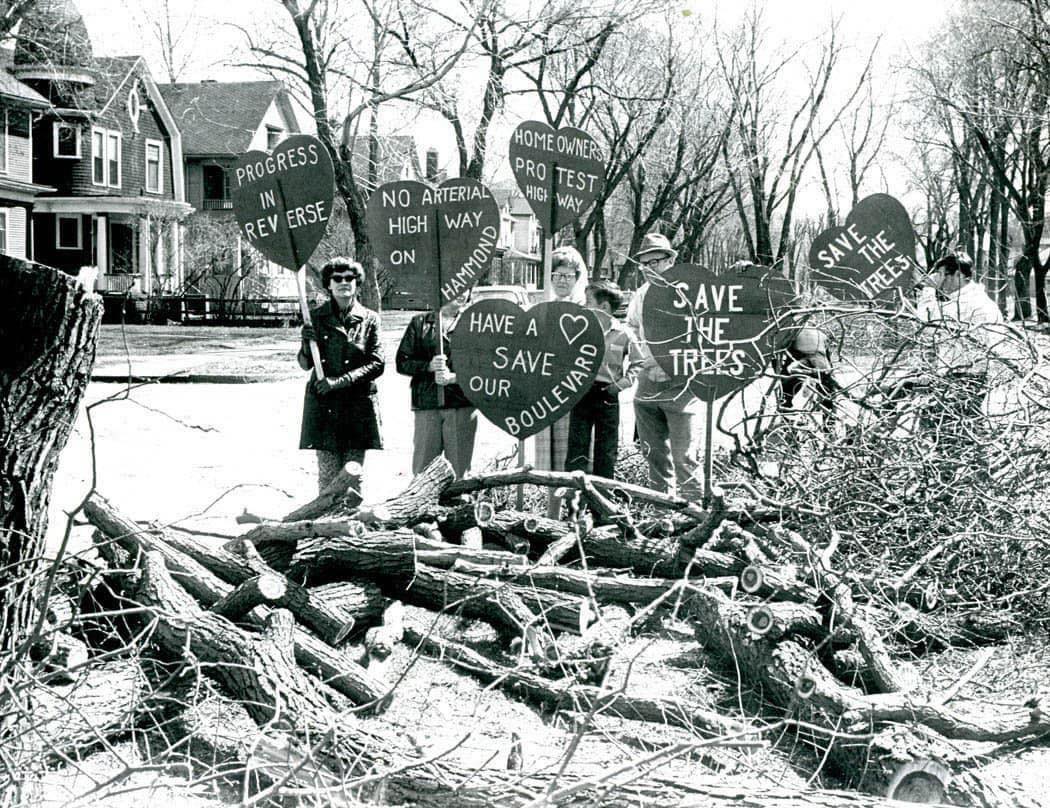
About 50 years ago, the City of Superior removed a boulevard filled with trees from Hammond Avenue. This fall, we put them back.
Until the middle of the 20th century, a median ran down the center of Hammond from the north end to 28th street. Large, leafy elm trees graced the center of the streets and ran along the sides in spacious boulevards. When Dutch Elm disease struck, large and dying limbs threatened pedestrians, passing vehicles and the surrounding homes. But when the city removed these dying trees, they didn’t replace them. Instead, they removed the median, expanding the surface of the roadway and creating a full-sized turn lane that ran the length of the entire street.
The neighbors protested, but why? What value did these trees hold and why did it matter if they left. Wasn’t a larger street better anyways? Safer? More efficient for traffic? Better for business even? The neighborhood said no. The people that built their lives and raised their families along Hammond saw the loss of a safe, quiet and peaceful neighborhood. They saw a wider street and more pavement as a direct threat to their property values, their way of life, maybe even to their lives.
We now know that they were right. Hammond wasn’t better for the loss of the trees. Traffic moved faster. Kids lost the ability to cross safely to the park or a friend’s house. The neighborhood looked uglier.
But what good is a tree? Surely even a whole street full of trees can’t make that much of a difference, right? Decades of research and examples from our own neighborhoods show us it can. In fact, planting trees might be one of the single-most effective ways to improve quality of life and safety in a neighborhood.
Trees offer all kinds of measurable benefits. They reduce flooding. A 1% increase in canopy cover in an urban forest (the sum of all trees in a city) results in a 1% reduction in stormwater runoff, reducing pollution to our creeks, streams, rivers and Lake Superior. They also reduce erosion by stabilizing bluffs and slowing the speed of runoff.
Trees improve public safety. Several studies show that lack of trees along a street, especially when that street is widened, can increase vehicle accidents by as much as 500% in the first 10 years. We can see this effect when we drive. A “tunnel” of trees narrows our vision of the road and keeps our focus just ahead of us, instead of in the far distance where we might miss more immediate hazards like a pothole, cross traffic or even a child chasing a ball into the street.
Take a drive south along Missouri Avenue in Billings Park. Start on Belknap and just drive to 21st, past Cooper School. Watch what happens to your driving as you enter the canopy that covers the neighborhood from 19th to 21st street. You’ll find yourself slowing down. The street didn’t change, it’s about 25 feet wide the whole way (except at the school, where we mysteriously allow it to widen an extra 10 feet), but your perception of the street changes considerably. In a disaster, where a car careens off at full speed, the trees step up and protect any children walking home from school and blocking traffic from reaching the sidewalk (except at the school itself where nothing at all keeps a runaway car on the road).
Trees are infrastructure. In fact, they are much more cost effective than their built counterparts. It’s easier to plant a tree than build a guardrail or install a concrete barrier. A major increase in public trees is just as effective and but nowhere near the cost of major new stormwater ponds. Sure, they take a while to grow, but once established, they do their jobs better every year, as opposed to their concrete counterparts, which degrade as they age.
The Hammond Avenue neighbors who protested the loss of their trees weren’t thinking about stormwater runoff. They probably weren’t really thinking about traffic speeds that much, even if it made for a good argument. When they picketed the street, they cut their signs in the shape of hearts. They fought against the loss of something deeper than street design. The towering elms that covered their neighborhood helped to define the place they lived. We don’t just live in monochrome boxes. We paint our houses and pick out window treatments and plant gardens and decorate for Christmas. Strong neighborhoods take pride in their homes and the surrounding neighborhood is a part of that home. The people of Hammond fought for beauty and nature in their lives.
We can’t measure what makes a neighborhood a great place to live. But we know it when we see it. We plant trees along and even within our streets to make Superior look better. It’s always good policy to make cost effective investments in public safety and environmental health. But that’s not why we do it. Trees growing strong and healthy along 28th street, or Hammond Avenue, or even within Tower Avenue impress our visitors and improve our pride in the beauty of our Northwoods City.
One last thing: Trees do everything I’ve described here and much more. For a plant, they make pretty great citizens. And like all good citizens they grow and get better at serving Superior. The city should and will continue to plant trees but if you want to be a part of it, reach out and consider joining our tribute tree program. If you cover the cost of planting a single tree, we’ll permanently dedicate it to the person, cause or organization of your choice.
Tribute trees remind anyone that passes by that we have great citizens and that, as a community, we are willing to make the kind of investments that can outlive us all.
Jim Paine is the mayor of Superior.