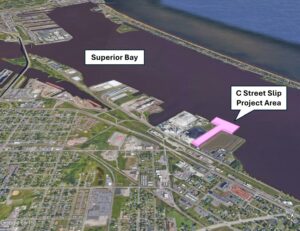
The upcoming reconstruction of the Blatnik Bridge is set to cause major disruptions in the Twin Ports for several years while MNDOT and WISDOT work together to construct a new bridge. Significant land is being taken by the state to facilitate the new construction.
On the Wisconsin side of the bridge, several businesses will have to be relocated. For those affected, WISDOT’s work has already begun to take the land the state needs for the project. How is it legal for the state to force a business or resident to move?
The answer is eminent domain.
The Fifth Amendment to the U.S. Constitution and Article 1, Section 13 of the Wisconsin Constitution provide that private property “shall not be taken for public use, without just compensation.” The Constitution thus puts two requirements on the state to take private property: first, the “taking” must be for a “public use,” and second, there must be “just compensation” paid by the state.
Whether taking qualifies as a “public use” has been a matter of significant controversy in recent years. Here in the Twin Ports, a bridge replacement is a straightforward example of public use, because land taken will be for a public right of way and related uses.
But what about taking property to facilitate private economic development? In 2005[1], the United States Supreme Court blessed a taking in favor of a largely private development so long as it provided a hypothetical net public benefit, such as “economic rejuvenation,” new jobs, increased tax revenue, and similar “public” benefits. Property taken need not be turned into a park or street owned by “the public” for a taking to be considered a “public use.”
The other requirement, “just compensation,” is also an area of heated debate. What property is worth can sometimes be in the eye of the beholder. Whether “just compensation” was paid is a significant area of litigation hinging on the expert testimony of appraisers, and even seasoned appraisers can disagree wildly about what a property is worth based on the choice of what comparable properties to look at, or by employing entirely different methods of appraisal such as replacement cost or looking at how much income a property produces. If your property is being taken by the state (or in some cases, a utility company), it’s important to ensure you are getting paid what it’s worth.
The law also recognizes that a person relocated by a taking faces significant costs beyond just the value of the land itself. A residential tenant may need to hire movers. A business may need to spend significant resources to identify a new location which is properly zoned and well situated to set up their new shop. A business may also need to put up new signs, change their business cards and myriad other incidental costs.
Wisconsin Statutes Section 32.25 and related regulations provide for relocation benefits to be paid to residents and businesses impacted by a taking to cover these various costs. Importantly, however, the statute is a reimbursement scheme, and if the state denies a request for relocation benefits, a relocated business may be stuck with these significant costs coming out of its bottom line. It’s important, therefore, to make sure that the relocation costs to be claimed are legally reimbursable before you are forced to move.
If you find yourself affected by an eminent domain action, it is important to understand your right to just compensation. You may want to ensure that what the state says your land is worth is a truly fair and accurate valuation. In some cases, your attorneys’ fees can even be paid by the state if they significantly undervalue your property. If you find yourself being relocated, it is equally important to understand your legal rights to reimbursements, to understand what is reimbursable under law, and to make sure you receive every penny you are entitled to when the State makes you move.
Contact the Fryberger Law Firm or an attorney of your choice to ensure you have all the information you need to make an informed decision.
James Aird is an attorney with Duluth-based law firm Fryberger, Buchanan, Smith & Frederick, P.A
[1] Kelo v. City of New London, 545 U.S. 469 (2005).