Staff at the Lake Superior National Estuarine Research Reserve Are Proud of Their Work
There are jobs, and then there are callings. For the people who work at the Lake Superior National Estuarine Research Reserve, they tend to perceive their occupations as falling more into the latter category.
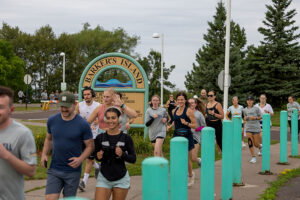
The 16,000-odd-acre Reserve (also sometimes referred to as the LSNERR) is a gathering place on Superior’s Barker’s Island where opportunities for learning, play, research, stewardship, outreach and much more are presented in a number of different ways.
One of 30 such Reserves in the country – most of which are on the West and East coasts – it’s a way for people of all backgrounds, ages and interest levels to learn all about the local waterways, and how they can be preserved and tended to for the enjoyment and good health of those who live in the region.
Humanity has luckily recognized that treating the natural world with disregard is not sustainable, and so the Reserve exists to help people learn about how the relationship between people and the wilds is a delicate one that needs to be tended to.
It’s a tricky time for the Reserve, though. Threats to funding from Washington have made the staff there worried that the future might bring tightened purse strings or worse. But they currently have hope that things will work out, and they are fully focused on doing their varied jobs – jobs that are truly valued by the people who hold them.
Deanna Erickson is the Reserve’s director. For her, being employed there is the culmination of her life’s goals.
“Working at the Lake Superior National Estuarine Research Reserve is definitely my dream job,” she said. “I’m from Thorp, Wisconsin, but my dad’s family comes from Swedish fishermen in Door County, and I feel most at home near the water. I spent about 15 years working in environmental education and land stewardship all over the place before landing here – from the Bay of Fundy in New Brunswick, Canada,to the Mojave Desert in California. After getting my master’s in education at UMD, I learned about the Reserve. It had just been designated and was hiring staff. I got lucky and landed the education-coordinator role, launching the Rivers2Lake education program and the Lake Superior Estuarium before becoming the director in 2020. The Reserve is a joint program between the National Oceanic and Atmospheric Administration and UW Extension. I grew up farming with my extended family and my dad worked in the ag industry – I came to this role with a lot of respect for Extension in Wisconsin.”
Erickson said the Reserve – designated in 2010 as one component of a system that began in 1972 when the Coastal Zone Management Act was passed by Congress – is “part of a network of 30 Reserves around the U.S. coast designated by NOAA to protect and study estuaries in collaboration with and in service to surrounding communities. Estuaries are river mouths where two chemically different bodies of water meet and mix. They’re full of life – birds, fish, plants – and are great places for communities to grow and experience nature. They help to build sustainable economies – they make great ports and, when cared for, are abundant with food and water resources. That’s why NERRS exist – so we can understand these places and make informed decisions about them.
“Right now, there are 12 people who work at the Reserve, along with many seasonal student researchers and educators,” Erickson said of the people who frequent the site. “We’re focused on the St. Louis River estuary primarily, but also work along the Lake Superior watershed. Staff do everything from mentoring K-12 teachers in Lake Superior-based science education to teaching college students, analyzing water samples, helping communities prepare for floods and address erosion and restoring the estuary alongside many partner organizations.”
During her time at the Reserve, Erickson has experienced a number of proud moments and high-water marks. The St. Louis River Summit – most recently held in early March – is one that she pointed to as being particularly notable.
“Imagine over 300 people gathered in one room to share what we’re doing for one amazing river,” she said. “That makes me proud every year, both of the community that works on land and water here, but also the Reserve staff. The Summit helps us get work done. It has increased collaborations, built cross-pollination between social and natural sciences and improves efficiency in research and restoration. Last year, someone wrote in an evaluation: ‘Best work day of the year, for me.’”
“Opening the Lake Superior Estuarium in 2017 was [another] big moment,” Erickson said. “The exhibit and classroom design took almost a year of my work life, and I think it’s a beautiful, engaging public space for visitors and locals that adds to Superior. Another moment of pride is when the new boat launch opened at Pokegama Bay in the Superior Municipal Forest. The Reserve successfully competed for funding for that project with the city, and it’s such a lovely spot, now. We take hundreds of kids out in canoes to explore the estuary, there.”
“I also love when I have a chance to make a difference, nationally,” Erickson said. “I served on a federal advisory committee last year that was helping NOAA improve coastal conservation and collaboration with Tribal Nations. It’s gratifying when you can influence coastal areas all around the country in a good way.”
It may be hard for the layperson to fully understand the scientific work that goes on at the Reserve, but it’s exacting, precision work that is all done in the service of ensuring the health of the natural world and every creature that lives in it from the top of the food chain on down.
“The Reserve research and monitoring staff are doing an incredible job tracking changes in water health that may be leading to more harmful algae blooms,” Erickson said. “While it’s not always the case, blooms can add toxins to the water that are harmful to people and pets. We recently launched a Lake Superior buoy and collect data every 15 minutes at four stations along the estuary. Making sense of that data and helping the community to respond is in our future.”
For Erickson, a lot of what she works toward is making the waterways of this part of the world easier to access and the forests healthier.
“I have dreams of helping the city, county and UWS create more public access points along the estuary and the lake,” she said. “I also know we’re rapidly losing ash trees in wetlands because of an invasive insect. Those trees are important for protecting the islands and shores they grow on, and restoring more forests with other species of trees is important to me. We’ve done that on 100 acres so far. We’ve been supporting a planning process to restore land at the end of Wisconsin Point with the Fond du Lac Band of Lake Superior Chippewa, and I want to find the funding needed to make that restoration happen.”
Erickson and her cohorts are people who work very hard not for themselves, but for the community and the communities of the future that will need to drink the water and use the land in this region after everyone who exists now has been replaced by subsequent generations.
Karina Heim is Coastal Training Program Coordinator at the Reserve, and has been since 2018. She has found that the various fields she has worked in during her life have provided her a toolkit that serves her perfectly, today.
“My current role at the Reserve somehow brings together all of my former career experiences – land-use planning, managing service programs, public lands outreach – and puts them together in this wonderful and unique way,” she said. “This is an extraordinary place, where the river and the lake meet and mix. As the Reserve’s coastal training program coordinator, I get to serve the land, water and local community by focusing on the needs of local decisionmakers. What questions and worries are facing local governments and natural resource managers? What environmental changes are they noticing, and what support do they need to change their practices? My job is to stay tuned into the challenges facing Lake Superior coastal counties, and then, drawing from the science and network of deep knowledge that our Reserve is a part of, bring tools and information that can help them overcome those challenges.”
Heim, like Erickson, marvels at the resource that the Reserve is.
“When you have a Reserve in your community, you have something special,” she said. “You get a full-service suite of dedicated professionals ranging from scientists to educators who want to help improve how we understand our unique estuary and help connect people to it in meaningful ways. You get the resources of a longstanding, nationally dedicated system pointed directly at your local place. With the resources of the Reserve system here in Superior, we can create more welcoming waterfronts, like the improvements at the Pokegama launch. We can watch closely how water is changing by collecting an enormous amount of data in the estuary in the same way every single year. We have staff that can build great relationships with local teachers and local leaders over time, bringing our experience and expertise into their classrooms and meeting rooms. Our facilities on Barkers Island are places where people can gather and learn.”
Heim mentions the publication of a guide – offered as a free digital download – as something that she found fulfilling.
“I am proud of Ganawenindiwag: Working with Plant Relatives to Heal and Protect Gichigami Shorelines and incredibly grateful to the author team and the cultural advisers who shaped [it] into the compelling resource that it became,” she said. “This book incorporates a blended-knowledge approach that weaves institutional ecological principles together within an Ojibwe cultural framework to guide coastal caretakers in their efforts to nurture and promote plants in shoreline environments.
“This spring,” Heim continued, “I was [also] proud to work with our research program to develop a new Algal Awareness training, focused on preparing water-resource managers to recognize and respond to cyanobacterial bloom events – which can be toxic – using both old tricks and some new tools. We gathered up research on blooms and packaged it in an accessible way to support the professionals who work on the front lines of our region’s water health.
“At the Lake Superior Reserve, the philosophy is truly place-based and focused on how we can serve our community,” Heim said. “In the nearly 15 years since designation, the Lake Superior Reserve has built a reputation as a trusted source for scientific- and water-health information, coastal restoration, Lake Superior-based education programs for thousands of PK-12 students and hundreds of teachers and training programs that bring resources and support to rural communities along Lake Superior’s shore. We deeply value our role in Lake Superior and St. Louis River communities.”
Ryan Feldbrugge is the Education Specialist at the Reserve since 2022, but he started as an intern. His job finds him helping to teach kids how important tending to the environment is. “A big part of my role is to work with pre-K through 12th-grade teachers in our professional-development program Rivers2Lake,” he said. “It’s a yearlong program. It’s sticky learning for students – we’re putting them in the position of authentic experiences in a place that they know and that they’re learning more about while we’re meeting standards and benchmarks.”
Depending on the grade level, the teacher’s goals and the students’ interests, the Reserve can provide just about any learning experience that is desired. “I mean,” Feldbrugge said, “last year, we had an elementary physical-education teacher with the dream to get her kids out on the ice and fishing for those motor skills and winter connections. Recently, we had every 8th-grade student in Superior come through here to learn about water chemistry and harmful algal blooms.”
Kids who visit the Reserve aren’t just on field trips – they’re learning lessons about how humanity interacts with and has an effect on nature, and these lessons can inform them as they begin to move into thinking about their future careers. Indeed, time spent there can inspire in deep ways that can ripple for years.
“We had a full-circle moment,” Feldbrugge said, “where we had a student who ended up working here with us on algae blooms. Was her time where she was a 6th-grader in Rivers2Lake a factor? I’d like to think so.”
Kristen Rhude is Stewardship Coordinator at the Reserve since 2021 who came there following a fellowship at NOAA in Maryland. Her role finds her dealing with a lot of restoration and conservation work. She’s planting trees in the field herself, sure, but she’s also dealing with the Wisconsin Conservation Corps and other entities to do the work that needs to be done to tend to the environment and ensure that it’s healthy for its own sake and for the sake of the animals that depend on it.
“It’s a great opportunity for young folks to learn about this place,” Rhude said. “They can think about where they want their future to lead, whether that’s future studies or different career paths.”
The Reserve provides education opportunities of many kinds. It provides work for conservationists and engineers. It’s become a vital part of the region.
“We provide a lot for both the environment and the community in this area,” Rhude said. “Also, I’m thinking about the partnerships that we have – no entity can do this, alone. We have education, outreach, research, stewardship – all under one roof, working together every day.”
There are a lot of people who work at the Reserve, but there are so many more who benefit from that work. This is what makes the specter of funding cuts such a distressing proposition for so many. But the fact is that the people who have made the Reserve such an important, vital place aren’t going to give up without a fight.
“We are in something of a tenuous time at the moment, as our federal funding is uncertain beyond this year,” Erickson said. “That does make it harder to plan, but we have so much good work to do in Superior going forward. I’m committed to finding a way.”
Tony Bennett is a freelance writer based in Duluth.